
We've watched members panic because their HRV dropped from 48 to 32 overnight. It meant nothing. They had a glass of wine, ate dinner at 9pm, and slept poorly. One bad night, one scary number, and suddenly their whole week was ruined by a metric they didn't understand.
If you own an Oura, Fitbit, Garmin, or Apple Watch, you're probably staring at a heart rate variability score every morning. And if you're like most people, you have no idea what to do with it. This guide walks you through your autonomic nervous system, vagal activity, parasympathetic tone, and how to read real HRV signal from daily noise.
Key Takeaways
- Your daily HRV score is noisy. A 20-30% day-to-day swing in healthy people is normal.
- Read your 7-day and 30-day rolling averages, never the single-day value.
- The biggest HRV movers are sleep, alcohol, zone 2 cardio, and chronic stress — in that order.
- Compare your HRV to your own baseline. Population averages are context, not targets.
- Act only on 3+ day drops or multi-week trend shifts, not single-night dips.
Why Your HRV Number Is Almost Useless on Its Own
Your daily HRV score, in isolation, is one of the most misleading numbers in consumer health tech. A single reading tells you almost nothing.
HRV responds to everything. What you ate. When you ate it. How you slept. Whether you're fighting off a cold. Whether your partner snored. Whether your dog jumped on the bed at 3am.
The number moves constantly. And that's the point.
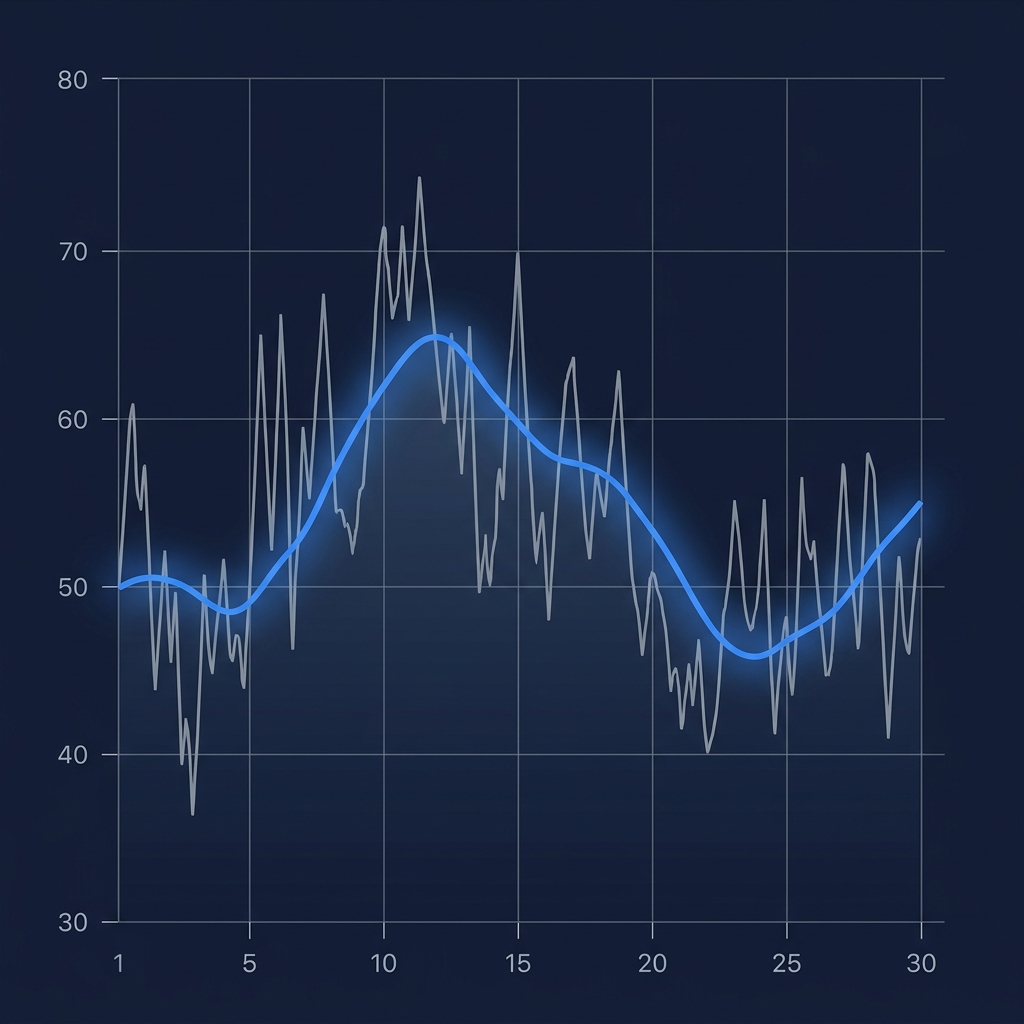
Marco Altini, the founder of HRV4Training and one of the more rigorous voices in this space, has written extensively about day-to-day HRV variability. His data shows that normal fluctuations of 20-30% between days are common in healthy people. So if your HRV goes from 48 to 32 one night, that's a 33% drop. Scary-looking. Actually normal.
You're not meant to react to the daily number. You're meant to read the trend.
Why Wearable Companies Push the Daily Score
Here's something most people miss. The daily "readiness" or "recovery" score exists because it's sticky. You check it every morning. It drives engagement. It does not, however, drive better health decisions.
Oura, WHOOP, and Garmin all know this. Read their research blogs carefully and you'll see their own scientists talk about trends, not daily values. The product surfaces a daily number because that's what sells. The insight is in the 30-day chart.
What HRV Actually Measures (30-Second Primer)
HRV stands for heart rate variability. It measures the tiny variations in time between your heartbeats.
Your heart doesn't beat like a metronome. Even at a steady 60 beats per minute, the gap between each beat varies by a few milliseconds. Those gaps are called R-R intervals.
Most wearables report HRV using a calculation called RMSSD (root mean square of successive differences). Oura, Fitbit, WHOOP, and Garmin all use it. Apple Health uses SDNN, which measures something slightly different. Higher RMSSD generally means more variability between beats, and more variability means your parasympathetic nervous system, the "rest and digest" side, is active.
When you're stressed, under-slept, fighting illness, or recovering from a hard workout, your sympathetic nervous system dominates and HRV drops. When you're recovered and relaxed, HRV rises.
In short, HRV is a window into your autonomic nervous system. It tells you how well-recovered your body is right now. What it isn't: a fitness test, a VO2 max, or a longevity score. A low HRV doesn't mean you're unhealthy, and a high HRV doesn't mean you're immortal. It's a recovery signal. Nothing more.
The "Your HRV vs Average HRV" Trap
Here's the biggest mistake we see people make. They Google "what is a good HRV" and find a chart saying the average 35-year-old has an HRV of 45ms. Their score is 38ms. They panic.
Don't do this.
Your HRV is compared to your baseline. Not the population's.
HRV by Age: Population Reference Ranges
These are rough population ranges based on data from HRV4Training, Elite HRV, and published research on large wearable datasets. They are not targets. They're context.
| Age Range | Typical RMSSD (ms) |
|---|---|
| 20s | 55-105 |
| 30s | 45-85 |
| 40s | 35-75 |
| 50s | 30-65 |
| 60s | 25-55 |
Notice how wide these ranges are. A 35-year-old with an HRV of 40ms is not broken. A 35-year-old with an HRV of 80ms is not a superhuman.
Twin studies suggest HRV is roughly 30-50% heritable. Some people just run low. Others just run high. Comparing your number to a friend's number is a waste of energy. What matters is whether your number is trending up, down, or sideways compared to you.
4 Signals Your HRV Is Actually Telling You
Once you stop staring at the daily number, HRV becomes genuinely useful. Here are the four patterns worth watching.
Signal 1: Chronic Downward Trend (2+ Weeks). If your 7-day rolling HRV has been drifting down for two weeks or more, something is off. Common causes: you're overtraining, under-sleeping, under-eating, or dealing with ongoing life stress. This is the signal that matters most. Chronic suppression means your body isn't recovering between stressors.
Signal 2: Sharp Single-Day Drop. You see a 20-30% drop from your baseline on a single day. Usually there's a clear cause: a late dinner, a drink or two, poor sleep, or the start of an illness. WHOOP's internal data, which they've published in blog posts, shows alcohol is one of the most reliable single-night HRV suppressors. Even one drink drops HRV in most people.
Signal 3: High Day-to-Day Variance. Your HRV swings wildly. 58 one day, 34 the next, 61 the day after. Your baseline is jagged, not smooth. This usually means inconsistent routines. Different bedtimes. Different meal times. Some days of stress, some days of calm. Your nervous system never settles.
Signal 4: Rising Baseline Over Months. Your 30-day rolling average is climbing. This is the goal. It means your fitness is improving, your recovery is getting better, and your body is adapting. Endurance athletes who add zone 2 cardio often see their baseline climb 10-20% over 8-12 weeks. This is the pattern you want to chase.
How These Signals Stack
In practice, you'll often see two or three of these at once. A rising baseline with occasional sharp single-day drops is very normal. A flat baseline with high variance is a sign something in your routine is unstable.
Learn to read them together, not in isolation. The story is usually in the combination.
What Moves HRV: The Evidence-Based Cheat Sheet
Here's a rough guide to how common inputs affect HRV. Magnitudes are based on published research plus what our team has seen in member data across thousands of nights.
| Lever | Direction | Rough Magnitude |
|---|---|---|
| Alcohol (2+ drinks) | Down | -10 to -25% next-night HRV |
| Late meal (within 3h of bed) | Down | -5 to -15% |
| Zone 2 cardio, regular | Up (over weeks) | +10 to +20% baseline |
| Sleep debt (under 6h) | Down | -10 to -20% |
| Breathwork, 10 min AM | Up (acute) | +5 to +10% same day |
| Cold exposure (2-3 min) | Up (acute, next day) | +3 to +8% |
| Chronic stress | Down (baseline) | -10 to -30% over weeks |
| Caffeine after 2pm | Down | -5 to -10% |
The Two Levers That Matter Most
Alcohol deserves special attention because it's the lever most people underestimate. Two glasses of wine with dinner can drop your next-night HRV by 25% and your deep sleep by 40%. If you've been confused by your HRV swings, track your drinks for two weeks. The pattern is often obvious.
Zone 2 cardio is the other big one. Zone 2 is low-intensity cardio you can do while holding a conversation. 150-180 minutes per week, sustained over 8-12 weeks, reliably moves HRV baseline up. This is the most boring, most effective HRV intervention we know of — and if you'd rather skip tracking it manually, OPH will watch your HRV baseline alongside your training load automatically.
Breathwork is worth a quick mention too. Slow breathing at roughly 6 breaths per minute, sometimes called resonance frequency breathing, has been shown in multiple studies to acutely raise HRV. The effect is real but short-lived. Great for stress management. Not a shortcut to a higher baseline.
How to Build a 30-Day HRV Baseline
Before you can read trends, you need a baseline. Here's how to get one that's actually reliable.
- Wear your device consistently. Same device. Every night. No exceptions. If you're bouncing between an Oura ring and an Apple Watch, the numbers won't be comparable. Pick one primary tracker for HRV.
- Measure at the same time and position. The gold standard is a nightly reading during deep sleep, which is what Oura, WHOOP, and Fitbit do automatically. If you're using an app like HRV4Training that takes a morning reading, take it at the same time, in the same position, within 5 minutes of waking.
- Ignore the first 7 days. Your first week of data is trash. You're adjusting to the device. The baseline hasn't stabilized. Discard it.
- Use a 7-day rolling average. Your daily number is noise. Your 7-day rolling average is signal. Most apps show this by default. If yours doesn't, export the data and calculate it yourself. This is the number you should care about.
When a Drop Matters (And When to Ignore It)
Here's the rule of thumb we use. It's not scientific, but it's worked well across the member data we've reviewed.
- One day below baseline: Noise. Ignore it.
- Three consecutive days below baseline: Signal. Look at your inputs.
- 7-day rolling average dropping: Real trend. Something is changing.
- 14-day rolling average dropping 10%+: Chronic stress or under-recovery. Act on it.
If you react to every single-day drop, you'll drive yourself insane. If you ignore every drop, you'll miss real problems.
Two Signals Worth a Closer Look
One exception to the noise rule: if your HRV drops sharply and you also see a resting heart rate spike of 5+ bpm, that combination often shows up 24-48 hours before you feel sick. Oura and WHOOP both flag this pattern. It's one of the most useful early-warning signals in consumer health tech.
The other: if you menstruate, HRV patterns track your cycle. Most people see HRV dip during the luteal phase (the week before your period) and rise during the follicular phase. Oura's cycle research, published on their blog, shows this pattern across hundreds of thousands of users. If you don't account for it, you'll misread week-to-week drops that are actually hormonal, not lifestyle-driven.

The Hardest Part: Connecting HRV to Everything Else
Here's where most people hit a wall. HRV by itself is interesting. HRV in context is powerful. And building that context manually is a nightmare.
Say your HRV dropped 18% this week. You want to figure out why. Possible causes include:
- Total sleep hours (did you sleep less?)
- Sleep timing (did bedtime shift?)
- Deep sleep minutes
- Alcohol (how many drinks, how close to bed?)
- Meal timing (when was your last meal?)
- Meal composition (carbs, protein, fat?)
- Caffeine timing
- Training load (was this week harder?)
- Stress events (work, relationships, travel)
- Ambient temperature while sleeping
- Cycle phase if you menstruate
- Supplements you started or stopped
That's 12 variables, and I'm underselling it. Humans can hold about 4 variables in their head at once before they start pattern-matching badly. This is a cognitive problem, not a data problem.
Why Spreadsheets Fail
We've tried. We've built the spreadsheets. We've color-coded the cells. We've made the scatter plots. You keep it up for three weeks and then you stop because life is short.
The data is there. Your Oura has it. Your Fitbit has it. Your food log app has it. The problem isn't collection. The problem is correlation across 30 days of 12-variable data, which is exactly the kind of work brains are terrible at and machines are great at.
How Autonomous AI Handles This
This is where OnePersonHealth fits in, and we'll keep it brief because the point of this article isn't a sales pitch.
OPH runs a nightly AI analysis that correlates your HRV against every other data stream you've connected: meals, sleep stages, training load, supplements, stress markers, hydration, lab results. It checks your data against 288+ evidence-based interventions across 17 health goals.
The output isn't another dashboard. It's specific next-morning recommendations. "Your HRV dropped 14% on nights you ate after 9pm. Consider shifting dinner earlier this week." That kind of thing.
HRV is a slow-moving signal with fast-moving causes. You need to check the correlations every night, not once a month. That's why OPH runs while you sleep. It's the only health AI we know of that does this autonomously.
Related read: the single biggest HRV driver is sleep quality, and most people's sleep is worse than they think. We broke down the 7 things to audit in the 7-night sleep audit. For the specific reason your HRV nosedives on nights you eat dinner too late, see why late-night eating wrecks your metabolism — overnight HRV drops 8–15% when you eat within 2 hours of bed.
HRV and Chronic Inflammation
One pattern worth mentioning. Chronically suppressed HRV, the kind that lasts months and doesn't respond to sleep or training adjustments, often correlates with elevated inflammatory markers.
If your HRV has been low for 6+ months and you can't explain it, it's worth looking at blood biomarkers. We covered the ones that actually matter in 5 blood biomarkers beyond cholesterol. hs-CRP, ferritin, and fasting insulin are the ones we'd check first.
This is a case where the wearable data and the lab data have to be read together. Neither one alone tells you much. Both together often tell you exactly what's going on.
How to Put This Into Action
Enough theory. Here's what to actually do, starting tonight.
- Pick one device and wear it every night for 30 days. Oura, Fitbit, WHOOP, Garmin, Apple Watch. Doesn't matter which. Consistency matters more than accuracy.
- Ignore the first 7 days of data. Let the baseline stabilize. Don't even look.
- After day 14, start tracking your 7-day rolling average, not the daily number. Most apps show this. If yours doesn't, export and calculate.
- Run one experiment at a time. Cut alcohol for 2 weeks. Or move dinner 2 hours earlier. Or add 150 minutes of zone 2 cardio. Change one thing, watch the rolling average.
- Only react to 3+ day drops or rolling average shifts. Single-day noise is not actionable. Commit to this rule.
- If you want the correlations done for you, connect your wearable to an analytics platform. See your HRV patterns auto-analyzed — try OPH free.
And a few things not to do. Don't compare your HRV to strangers on Reddit. Don't buy supplements because an influencer said they raise HRV. Don't train harder on high-HRV days and rest on low-HRV days until you've watched your own baseline for at least 60 days. Most "HRV hacks" are noise. The real gains come from sleep, cardio, alcohol reduction, and stress management. Boring. Effective. If you want to pick just a few levers to own for the next 90 days, see the 3-habit stack that predicts 80% of long-term health outcomes.
A Quick Word on Device Accuracy
People ask which device is most accurate. Short answer: they're all "accurate enough" if you use them consistently.
Oura tends to show higher absolute HRV values than Fitbit or WHOOP. Apple Watch uses SDNN instead of RMSSD, so the numbers aren't directly comparable. What matters is your trend on your device. Don't switch mid-experiment.
If you want gold-standard accuracy, a Polar H10 chest strap paired with the HRV4Training app is as close to lab-grade as consumer gear gets. For most people, the wrist or ring device you already own is fine.
One honest caveat: Apple Watch and Garmin both sample HRV less frequently than Oura and WHOOP. That makes their numbers noisier on a daily basis. If you're using one of those and the daily number feels random, trust the weekly average even more than usual.
The Bottom Line
Your HRV number is a signal, not a scoreboard. One day means nothing. Seven days mean something. Thirty days mean a lot.
Build your own baseline. Ignore the population averages. Watch the rolling average, not the daily number. Run one experiment at a time. And let the boring levers, sleep, cardio, less alcohol, do the heavy lifting.
The question isn't "is my HRV good?" The question is: is your HRV better this month than last month, and do you know why?