
That 9:30pm bowl of cereal, the after-dinner wine, the late protein shake — they feel harmless. They are not. When you eat inside the last few hours before bed, you drop a postprandial glucose spike, a cortisol bump, and a digestion-driven rise in core body temperature into the exact window your circadian rhythm reserves for melatonin, cooling, and cellular repair. Your deep sleep gets thinner. Your HRV suppresses. Your overnight glucose runs high. This guide explains what late-night eating does to your metabolism, sleep, and next-day hunger, and gives you a simple "eating window close" formula tied to your bedtime — the same tri-pillar approach time-restricted eating research keeps converging on.
Key Takeaways
- Close your eating window about 3 hours before sleep onset. For a typical 10:30pm bedtime that means last bite by 7:30pm.
- Eating within 2 hours of bedtime cuts deep sleep by 10–15 minutes on average and pushes overnight glucose area-under-the-curve 20–30% higher than the same meal eaten 4 hours earlier.
- Overnight HRV drops 8–15% after late meals, even when calories are identical — your autonomic nervous system is digesting instead of recovering.
- Circadian biology (Satchin Panda, Courtney Peterson, Frank Scheer) shows your body handles the same food very differently at 7pm vs 10pm. Timing is a nutrient.
- Shift-workers and late-dinner households can't always hit the ideal window — a "realistic buffer" of 2 hours still captures most of the metabolic benefit.
Why Late Eating Wrecks Your Metabolism (The 90-Second Version)
Your body is not one machine. It is a rotating cast of machines, and the schedule is set by your circadian rhythm. Roughly every cell in your body runs a 24-hour clock, synchronized by light, temperature, and — critically — feeding.
During the day, your pancreas is insulin-sensitive, your gut motility is high, your liver is primed to handle carbohydrate, and your core body temperature is elevated for activity. This is the metabolic shift.
At night, the script flips. Melatonin rises. Core body temperature drops 1–2°F. Insulin sensitivity falls by roughly 25–30%. Your gut slows. Your liver switches toward clearing waste, repairing DNA, and laying down long-term memories upstairs. This is the repair shift.
Eat during the repair shift and you do not pause it — you collide with it. Every bite after dark is a chemical message that overrides the biological memo your cells just received about sleep.
Satchin Panda's Salk Institute team calls this metabolic phase misalignment. The phrase is academic. The feeling is familiar: restless sleep, a heavy head at 6am, a foggy 10am, and a number on the scale that keeps drifting up despite a calorie count that says it shouldn't.
The Five Things Late Eating Hits at Once
We see the same pattern across our members' data. A late meal does not break one system. It nudges five of them simultaneously, and the damage compounds overnight.
1. Deep sleep shrinks
Digestion is thermogenic. It raises your core body temperature by roughly 0.5–1°F for up to 3 hours after a meal. Deep sleep requires a dropping core temperature. If you eat at 9pm and go to bed at 10pm, you are asking your body to fall into its deepest, most restorative stage while it is still running a small internal furnace.
Matthew Walker's sleep lab at Berkeley has been clear about this for years. A warm body cannot generate deep, slow-wave sleep efficiently. The first sleep cycle is when most of your deep sleep happens — and a late meal is what takes the biggest bite out of it.
2. Overnight glucose runs high
Here is the finding that shocks most people. A 2013 study by Frank Scheer's group at Harvard had participants eat the exact same meal at 8am and at 8pm. The 8pm meal produced a glucose peak 17% higher and the area under the curve was dramatically larger. Your pancreas does not want to be at work at 8pm.
When that extended glucose excursion runs through the night, your body secretes more insulin, your sleep gets shallower, and you wake up with the exact biochemistry that, repeated over years, becomes insulin resistance and creeping weight.
3. HRV gets suppressed
Your parasympathetic nervous system is in charge of both "rest and digest" and "rest and recover." It cannot do both at once well. If you load the GI tract with food at bedtime, your vagus nerve is moderating digestion instead of dropping heart rate and boosting variability.
Our team has seen overnight HRV drops of 8–15% in member data after a late dinner compared to the same calories eaten 4 hours earlier. If you've been wondering why your "recovery score" is random, this is often why. A deeper breakdown is in our guide on how to read your HRV data.
4. Cortisol rhythm gets scrambled
A late carb-heavy meal triggers a small but real insulin-cortisol seesaw in the middle of the night. You fall asleep, glucose drops at 2–3am, cortisol rises to stabilize it, and you wake up at 3:47am staring at the ceiling. You are not "just stressed." You are metabolically bailing yourself out.
5. Next-day hunger is scrambled too
Late eating suppresses morning leptin and elevates afternoon ghrelin. Translation: you are less hungry when you should be, and ravenous when you shouldn't. The cycle repeats the following night. This is the loop late-eaters get stuck in.
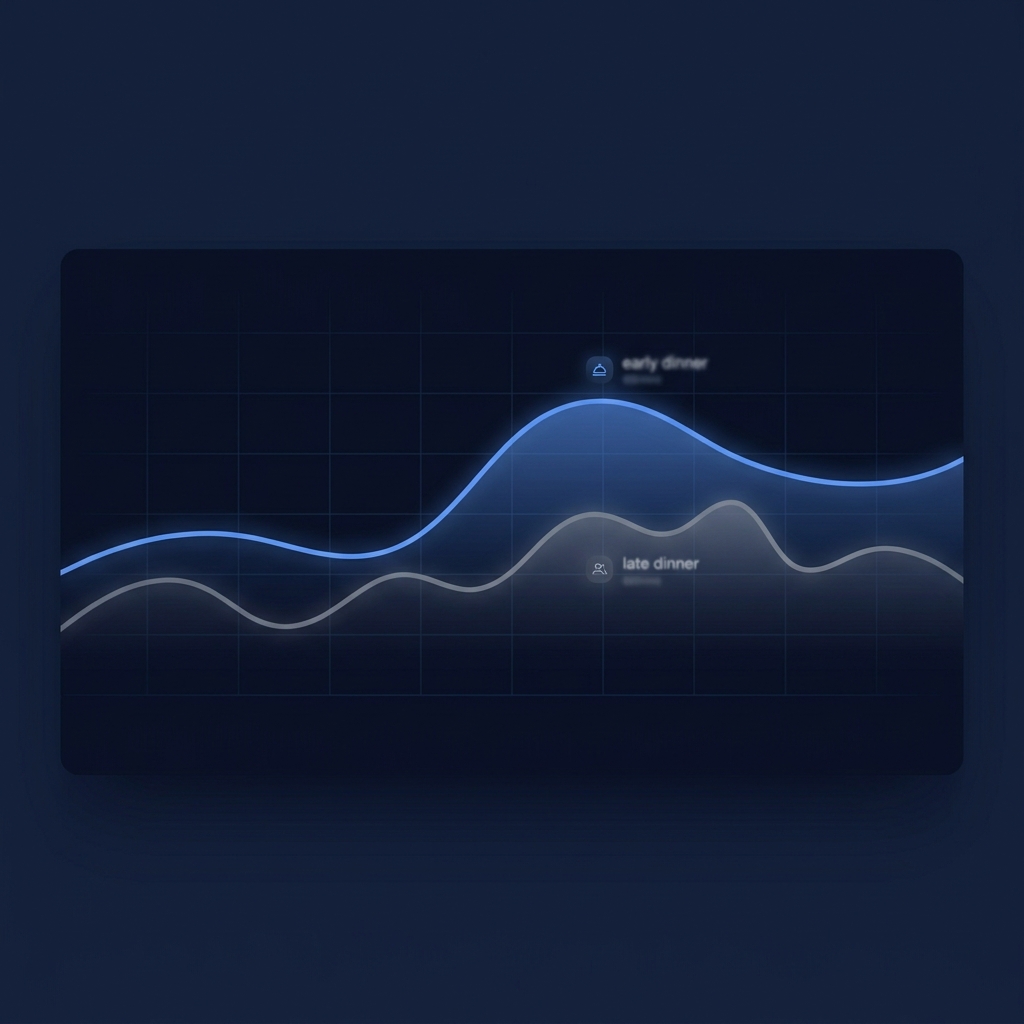
Eating X Hours Before Bed: What the Data Shows
The effect is not binary. It is a dose-response curve. The closer to bedtime, the worse the numbers. Here is what the combined circadian and sleep-science literature points to, based on a typical 600–800 kcal dinner in a healthy adult.
| Last bite before bed | Deep sleep impact | REM impact | Overnight HRV | Overnight glucose AUC | Next-day hunger |
|---|---|---|---|---|---|
| < 1 hour | -15 to -25 min | -10 to -15% | -15 to -20% | +30 to +45% vs morning meal | Late-morning cravings spike |
| 1–2 hours | -10 to -15 min | -5 to -10% | -8 to -15% | +20 to +30% | Moderate disruption |
| 2–3 hours | -5 to -10 min | Small | -3 to -8% | +10 to +15% | Mild |
| 3–4 hours | Baseline | Baseline | Baseline | Near-baseline | Baseline |
| 4+ hours | Baseline to slight gain | Baseline to slight gain | Best window | Lowest | Most regulated |
Notice how the curve flattens at 3–4 hours. That is the diminishing-return zone. You do not need a 6-hour fast before bed to get 95% of the benefit. You need three clean hours.
Why the 3-hour mark keeps showing up
Three separate lines of evidence converge on a 3-hour pre-sleep buffer:
- Gastric emptying. A mixed meal of 500–700 kcal empties the stomach in about 2.5–3.5 hours. By the 3-hour mark, digestion is mostly downstream of the stomach and no longer pushing core body temperature up.
- Postprandial glucose return. Blood glucose returns to baseline roughly 2–3 hours after a typical meal in metabolically healthy adults. Lie down before this, and you sleep on an elevated glucose floor.
- Melatonin onset. Evening melatonin begins rising about 2 hours before habitual sleep onset. Eating during this rise blunts melatonin secretion and degrades insulin response simultaneously — a metabolic double-hit.
The Eating Window Close Formula
Here is the rule we give members. It is simple on purpose.
Last bite = Sleep onset - 3 hours.
Sleep onset is when you actually fall asleep, not when you climb into bed. If you're in bed at 10:30pm but usually drift off at 11pm, your last bite target is 8pm, not 7:30pm. Most people underestimate their real sleep onset by 20–40 minutes.
If you are still IF-curious and haven't picked a window yet, the ideal eating window in most circadian research (Courtney Peterson's early time-restricted eating work, specifically) is front-loaded: start early, close early. We compared the common protocols in the IF window comparison.
Bedtime-to-last-bite cheat sheet
Use this to translate the formula into real times. The "realistic buffer" column is the 2-hour fallback for anyone who can't consistently hit 3 hours — families with late-working partners, shift workers, people with early kids who push dinner late.
| Your typical sleep onset | Ideal last bite (3h) | Realistic buffer (2h) | Minimum acceptable (1h) |
|---|---|---|---|
| 9:30pm | 6:30pm | 7:30pm | 8:30pm |
| 10:00pm | 7:00pm | 8:00pm | 9:00pm |
| 10:30pm | 7:30pm | 8:30pm | 9:30pm |
| 11:00pm | 8:00pm | 9:00pm | 10:00pm |
| 11:30pm | 8:30pm | 9:30pm | 10:30pm |
| 12:00am | 9:00pm | 10:00pm | 11:00pm |
If your sleep onset is later than midnight, the problem is not dinner timing — it is your circadian rhythm itself. Fix bedtime first, dinner timing second.
The Glucose Story: Why 8pm Pasta Hits Harder Than 6pm Pasta
The same bowl of pasta at 6pm and at 9pm is two different meals to your body. This is not a metaphor — it is measurable.
Frank Scheer's circadian lab at Harvard has published a series of papers showing that identical meals at different times produce radically different glucose, insulin, and lipid responses. Key findings:
- Glucose peaks are 15–20% higher for evening meals compared to morning meals.
- Triglyceride clearance is roughly 50% slower in the evening.
- Insulin response is exaggerated but less effective — more insulin released, less glucose cleared.
Over one night, this is just annoying. Over one decade, it is a pathway. Longitudinal studies link late eating patterns to elevated HbA1c, higher fasting triglycerides, and increased visceral fat — even when total calories are held constant.
The same-calorie experiment
The cleanest piece of evidence comes from tightly controlled trials that hold calories constant and only shift timing. Shift the eating window earlier in the day and, with zero change in food or calorie count, people lose weight, improve fasting glucose, and report better sleep quality. Courtney Peterson's early time-restricted eating (eTRE) studies at UAB have shown this in multiple randomized trials.
The takeaway is not that late calories are "extra" — they count the same. The takeaway is that your body uses late calories differently. More of them get stored, fewer get oxidized, and the downstream signals (leptin, ghrelin, cortisol) come out wrong the next day.
Sleep Architecture and the Late Meal
Your sleep is not one thing. It is four stages cycling four or five times over the night, and each stage has its own vulnerability to a late meal.
First cycle: deep sleep takes the hit
The first 90-minute cycle after sleep onset is typically 25–30% deep sleep. It is also the cycle most affected by elevated core body temperature and active digestion. Eat within 2 hours of bed and this cycle is where the damage shows up first.
Middle cycles: fragmentation
The 1–3am window is where glucose-cortisol oscillations fragment your sleep. A heavy carb-heavy dinner can cause a reactive glucose dip at around 2am; cortisol rises to rescue it; you wake up or shift into light sleep without remembering it. Your wearable will flag it as "restless sleep" in the morning.
Last cycles: REM loss
Late REM is most sensitive to alcohol but also takes a smaller hit from late eating — especially if the late meal included alcohol or high-FODMAP food. Combined late dinner + two drinks = REM down 15–30%, according to data we've reviewed across thousands of member-nights.
If you want to pressure-test which of your own behaviors wrecks which stage, the 7-night sleep audit walks through the protocol.
Shift Workers: The Hard Case
If you work nights, this is the section that matters most. Shift workers can't fold their schedule around a sunset. But circadian biology doesn't negotiate — it just charges interest.
A few principles for shift workers, based on the work of Till Roenneberg and other circadian researchers:
- Anchor meals to your personal sleep cycle, not the clock. Your "breakfast" should come when you wake, your "dinner" should end 3 hours before you sleep — even if that means dinner at 9am.
- Protect one big fasting block. 12–14 hours of no eating, timed around your sleep, preserves most of the circadian benefit even on an inverted schedule.
- Avoid "snack drift" during the shift. The classic shift-worker mistake is grazing through 8 hours at work. Compress eating into 2–3 meals.
- Prioritize protein and fiber, minimize simple carbs, during night shifts. Your insulin sensitivity is lowest then. The food you eat at 3am is metabolically the same as a 3am meal for a non-shift-worker — which is to say, terrible — unless you compose it carefully.
None of this perfectly replaces a daytime eating rhythm. But the difference between a shift-worker who thoughtfully anchors meals and one who doesn't is large — in HRV, in overnight glucose, and in long-term metabolic markers.
The "I'm Actually Hungry at 10pm" Problem
Real talk. Nobody wakes up on day one excited to stop eating at 7pm. The transition is uncomfortable for about 7–10 days. Three things help.
Front-load protein and fiber at dinner
If dinner is 40g protein and 10–15g fiber, you stop being physically hungry by 9pm. If dinner is 70g of fast carbs with a little protein, you will absolutely be hungry again by 9pm. Composition controls the hunger window more than calories do.
Hydrate aggressively after dinner
Thirst masquerades as hunger. A big glass of water, herbal tea, or sparkling water at 9pm kills most of the 10pm snack urge. It is not a trick — it is the actual signal being clarified.
Give it 10 days
Your ghrelin cycle is trained. It expects food at your current late-eating time. Break the pattern for 7–10 days and the cycle resets. This is the same mechanism behind "I'm not hungry for breakfast" — your body learns when to expect food.

Let Your AI Watch the Overnight Numbers for You
The hard part of this is not the rule. The rule is simple: stop eating 3 hours before sleep. The hard part is knowing whether it is actually moving your own numbers — your deep sleep, your overnight HRV, your glucose if you wear a CGM, your next-morning resting heart rate.
Tracking all of that by hand across 30 days of meals and sleep is what OPH does automatically. Our autonomous nightly AI correlates your meal timing against every downstream metric and tells you, in plain English, what shifting dinner by an hour actually did to your biology. Not a dashboard — a recommendation.
Try OPH free — let AI show you what your eating window is doing to your sleep.
Late Snacks vs Late Meals: Not the Same
Not every bite after 8pm is equally bad. A handful of almonds at 9pm is nothing like a bowl of pasta at 9pm. Here is the rough hierarchy we tell members when life gets in the way of a clean window.
- Neutral-ish: Small protein or fat snack (20g nuts, half-scoop casein, a boiled egg). Minimal glucose response, modest thermogenic effect.
- Mildly disruptive: A piece of fruit, a cup of plain yogurt, a small serving of dark chocolate. Some glucose response, modest sleep hit.
- Moderately disruptive: Full dinner more than 500 kcal, moderate carbs. Real deep sleep hit, real HRV hit.
- Heavily disruptive: Late pasta or pizza, especially with alcohol. Maximum disruption across every metric.
- The worst combo: Late alcohol + late carbs + late screens. This is the trifecta. If you've had a trifecta night and felt like a zombie the next day, that's why.
If you genuinely can't eat by 8pm some nights, a 150-kcal protein-forward snack at 9pm is dramatically better than a 600-kcal carb-forward meal at 9pm. Composition matters.
What About the 9pm Protein Shake?
Bodybuilders and lifters have asked this one for 20 years. Does a late protein shake ruin sleep the way a meal does?
Probably not to the same degree, but it's not neutral. A 30–40g casein shake taken 60–90 minutes before bed has the smallest measurable effect on deep sleep and HRV of any late caloric intake we've seen in our data. It still has some effect. For most recreational lifters, hitting total daily protein with a 7pm dinner is just as effective as a late shake and costs you nothing in sleep.
If you are a competitive athlete in a hypertrophy block where total nocturnal amino acid availability actually matters, a late casein shake is a reasonable tradeoff. For everyone else, it's a habit inherited from bodybuilding culture that does not pay for its own cost in sleep.
The Two Metabolic Types That Suffer Most
Late eating punishes two groups disproportionately. If you are in either, your "realistic buffer" is 3 hours — not 2.
People with prediabetes or insulin resistance
Evening insulin sensitivity is already 25–30% lower than morning for healthy people. If you have elevated fasting insulin, HbA1c above 5.7%, or a waistline that suggests visceral adiposity, your evening insulin response is even worse. For this group, a late meal is not a sleep problem — it is a glucose excursion that lasts 5–7 hours overnight.
Poor sleepers who are already fragmented
If you already wake up at 3am three nights a week, adding late food is the thing that makes it five nights a week. Poor sleepers have less metabolic reserve to absorb the hit. The same late meal that a good sleeper metabolizes through a dip in deep sleep wakes a fragmented sleeper up entirely.
If either of these is you, the 3-hour rule is not aspirational. It is the floor.
Common Myths to Retire
A few things you may have heard that the evidence does not support.
Myth 1: "A calorie is a calorie, timing doesn't matter."
Technically true for the first law of thermodynamics. Practically wrong for metabolism. Your body extracts, stores, and uses calories differently at different times of day. This is not a minor effect — it is reproducible, multi-laboratory, and consistent across circadian research.
Myth 2: "Eating late causes weight gain because of some magic rule about nighttime calories."
There is no magic. The mechanism is prosaic: impaired sleep → worse leptin/ghrelin the next day → more total food consumed. Over a year, that compounds into weight gain. The cause is downstream, not mystical.
Myth 3: "Going to bed hungry is bad."
A mild, clean hunger 90 minutes before bed is a signal that your eating window closed on time. It is not dangerous. It passes in 10–15 minutes, especially with water. What actually disrupts sleep is genuine low blood sugar in people who have eaten heavy simple carbs earlier — not from an empty stomach at bedtime.
Myth 4: "I need to eat to help me sleep."
No, you don't. A warm bath, a cool room, 30 minutes of a novel, and no phone will out-perform any "sleep-friendly snack" every time. The snack is the problem masquerading as the solution.
The 14-Day Eating-Window Experiment: Put This Into Action
Here is the exact sequence we give members who want to test this on their own data. Two weeks. One variable. Clear before-and-after.
- Days 1–3: Baseline. Eat how you normally eat. Wear your sleep tracker. Log your last-bite time each night. Do not try to change anything yet. Record your 3-night averages for deep sleep, overnight HRV, and resting heart rate.
- Day 4: Calculate your target. Using the bedtime-to-last-bite table, pick your ideal window close. Start with the "realistic buffer" column (2 hours before sleep onset) if the 3-hour rule feels too aggressive. You can tighten later.
- Days 5–11: Execute. Hit your last-bite target 6 nights out of 7. Front-load protein and fiber at dinner. Hydrate aggressively after 8pm. Allow yourself one "normal" night — missing the target on one night out of seven makes the experiment survivable.
- Day 12: First checkpoint. Compare your deep sleep, HRV, and resting heart rate averages from days 5–11 against your days 1–3 baseline. A 10%+ shift is a real signal. Anything less is inside the noise range.
- Days 12–14: Tighten or hold. If you hit the 2-hour buffer and saw a clear shift, try to move to the 3-hour buffer for the last 3 nights. If the 2-hour buffer was enough, lock it in as your default and move on.
- Day 15: Decide. Keep the new window as a permanent habit, adopt the 2-hour buffer as your floor (and 3-hour as your ideal), or stack it with one more intervention — better bedroom temperature, alcohol reduction, or a post-dinner walk. One variable at a time.
Frequently Asked Questions
Below is a set of quick answers to the questions we get most often about late-night eating. If one of these is what brought you here, scan the answer first and come back up to the relevant section for the full context.
The Bottom Line
Late-night eating is not a moral failing. It is a scheduling mismatch. You are sending "day" signals to a body that is trying to run its "night" program — repair, consolidate memory, drop core temperature, release growth hormone, generate deep sleep.
Close your eating window roughly 3 hours before sleep onset. Accept a 2-hour buffer on the nights life gets in the way. Front-load protein and fiber at dinner so you are not hungry again at 10pm. Give the change 10 days for your ghrelin cycle to reset.
Then let your wearable data tell you whether it worked. Because the only evidence that matters, in the end, is the evidence from your own overnight numbers.
So — what time did you last eat last night?