
If a generic "10 tips to sleep better" listicle was going to fix your sleep, it would have fixed it by now. This guide gives you a structured 7-night self-experiment — run by you, on your own wearable data — that isolates one sleep variable per night so you can name your #1 recovery killer by next Sunday. It covers sleep debt, deep sleep, REM, circadian rhythm, and the interventions that actually move the numbers.
Key Takeaways
- Run a 7-day baseline first — without it, single "good nights" mean nothing.
- Change one variable per night across 7 nights: caffeine timing, screens, room temp, alcohol, dinner timing, post-meal walk, magnesium.
- Ignore your wearable's composite sleep score. Track 6 raw metrics instead: total sleep, deep sleep minutes, REM minutes, resting HR, HRV, sleep latency.
- Only trust changes of 10%+ above baseline — anything smaller is night-to-night noise.
- Most people's #1 lever turns out to be alcohol, late food, or a warm bedroom.
"I slept 8 hours and still feel wrecked"
You set a 10:30 bedtime. You hit it. Your watch says 8 hours and 12 minutes. And you still woke up like someone ran a small marathon inside your skull.
If that sounds like you, generic sleep advice has already failed. You have read the 10-tip listicles. You own the blackout curtains. You still feel off.
The problem is not the tips. The problem is that nobody told you which tip actually moves your numbers. That answer is personal, and it hides in your wearable data.
Sleep is one of the few health variables you can measure every 24 hours without a lab, a prescription, or a new habit. You are already collecting the data. You are just not reading it with a plan.
That is what this piece is. A plan. Seven nights, one change per night, one clear answer at the end.
Why "try 10 things at once" tells you nothing
Most sleep advice hands you a pile of habits and says "do them all." You cut caffeine, you ditch screens, you drop the thermostat, you swallow magnesium, and you sleep better. Great. But which one did it?
You do not know. And because you do not know, the first week you skip any of them, your sleep collapses and you cannot tell why.
Stanford Sleep Lab researchers call this the "stacked intervention problem." When five variables move at once, you learn nothing about any single one.
You also build up a set of rules you half-believe in. Maybe magnesium works for you. Maybe it does not. Maybe your wine glass is fine. Maybe it is the reason your resting heart rate has crept up 6 bpm since January. Guessing is not a strategy.
The one-variable rule
Change one thing per night. Hold everything else as close to normal as possible. Measure. Compare.
This is the same method a clinical trial uses. You are going to run a 7-night trial with a sample size of one, and the subject is you.
What you need before night one
Do not start the audit tomorrow. Set up first. Five minutes of prep is the difference between data and noise.
The 6-item pre-audit checklist
- A sleep-stage wearable. Oura, Whoop, Garmin, Apple Watch with AutoSleep, or Fitbit all work. You need total sleep time, deep sleep, REM sleep, and resting heart rate at minimum.
- A 7-day baseline. Measure your current sleep for a full week before you change anything. Without a baseline, you have nothing to compare against.
- A one-line journal. Each night you write: "Tonight I changed X. Expected effect: Y." That is it.
- A clean window. No travel, no alcohol binges, no illness, no big deadlines. Pick a normal-looking work week.
- A fixed wake time. Wake at the same time every morning, within 20 minutes. Your circadian rhythm cannot be part of the experiment.
- A caffeine log. Write down every coffee, tea, and pre-workout. Caffeine leaks into sleep data even on nights you do not test it.
That baseline week matters more than anything else on the list. Sleep varies by 10 to 15 percent night to night even when nothing changes. Without a 7-night average to compare against, a single "good" night means nothing.
How to read your sleep score honestly
Your wearable gives you a headline number. "Sleep score: 84." Ignore it for now. That score is a weighted average the company invented, and the weights change between firmware updates.
You want the raw ingredients. Six of them.
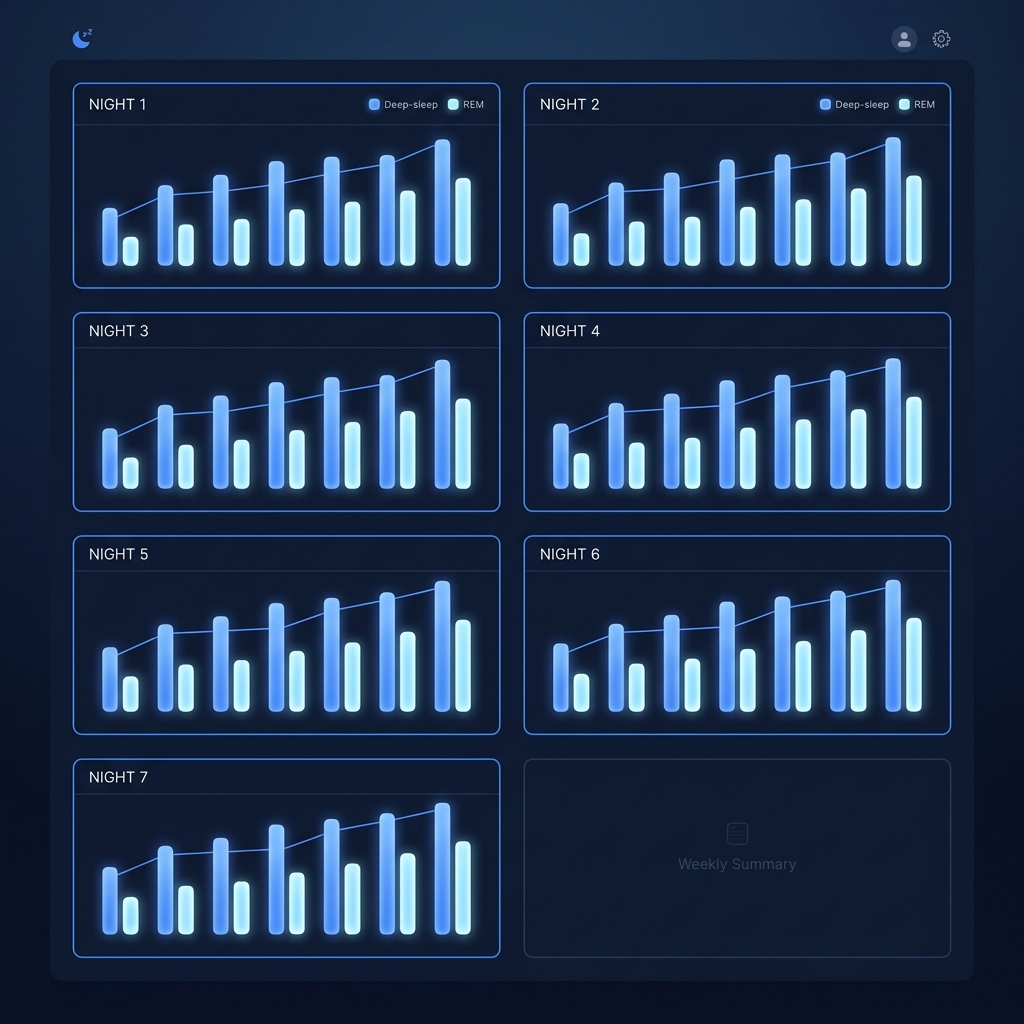
The six metrics that actually matter
- Total sleep time. Minutes, not hours. This is the least noisy number on your watch.
- Deep sleep minutes. Track minutes, not percentage. A percentage of a short night lies to you.
- REM sleep minutes. Same rule. Raw minutes are honest.
- Resting heart rate during sleep. The lowest stable heart rate your watch saw. A 3 to 5 bpm jump usually means something ate into your recovery.
- HRV during sleep. Heart rate variability during your deepest window. A strong sleep-recovery signal, and the one most sensitive to alcohol and late meals. For a deeper breakdown, read our guide on how to read your HRV data.
- Sleep latency. How long it took you to fall asleep. Under 20 minutes is healthy. Under 5 minutes is sleep debt.
Write these six down each morning for your baseline week. Your 7-night average for each one is your "before" picture.
The 7 nights
Here is the protocol. One change per night. You will feel like you are moving too slowly. Do not skip ahead.
Night 1: Cut caffeine after 2pm
Caffeine has a half-life of 5 to 6 hours. That 4pm espresso is still blocking adenosine receptors at 10pm. Your brain literally cannot register that it is tired.
Matthew Walker, author of Why We Sleep, calls the afternoon espresso "the most underestimated sleep disruptor in the professional world." He is not wrong.
Expect faster sleep onset and a bump in deep sleep minutes. Effect size is medium but reliable. People who drink more than 300mg of caffeine per day (about 3 strong coffees) tend to see the biggest change on this night.
Night 2: No screens 90 minutes before bed
This one is not about blue light. Blue-light filters help a little. The real issue is mental activation.
Email, Slack, social feeds, and Netflix cliffhangers all push your sympathetic nervous system into gear. Melatonin release gets delayed by 30 to 90 minutes.
Put the phone in another room. Read paper. Expect 5 to 15 extra minutes of deep sleep and a faster drop into sleep.
If 90 minutes feels impossible, start with 45. You are testing effect, not martyrdom. Just hold the same cutoff for the whole night so your data is clean.
Night 3: Bedroom at 65°F / 18°C
Your core body temperature has to drop about 1 to 2°F for sleep to initiate. A warm room stalls that drop.
The American Academy of Sleep Medicine (AASM) recommends 65 to 68°F. Most bedrooms in winter sit at 70 to 72°F with the heat on.
Set the thermostat low, open a window, or run a fan. Expect fewer mid-night wakes, higher sleep efficiency, and a real bump in deep sleep.
Night 4: Zero alcohol
If you are a zero-alcohol person already, skip to night 5. Everyone else, pay attention.
Alcohol is a sedative, not a sleep aid. It knocks you out fast, then shreds the second half of your night. REM sleep takes the biggest hit, sometimes dropping by 40 percent after two drinks.
Former Navy SEAL sleep doctor Kirk Parsley puts it bluntly: "Alcohol is the single largest variable in most high performers' bad sleep data." Expect a 15 to 30 percent REM rebound on a dry night.
HRV will move too. It is common to see an overnight HRV bump of 10 to 20 percent on your dry night compared to a two-drink night. That is your nervous system saying thank you.
Night 5: Dinner before 7pm
Late eating forces your body to digest during the first half of sleep. Digestion raises heart rate and suppresses HRV exactly when your autonomic nervous system should be calming down.
Try a 3-hour gap between your last bite and lights-out. If you usually eat at 8:30pm, that means dinner at 7pm with a 10pm bedtime.
Expect a lower resting heart rate overnight and a noticeable HRV bump. Early-dinner night is the one that often surprises people with how big the change is.
Night 6: 20-minute walk after dinner
A slow walk 30 to 60 minutes after eating clears glucose out of your bloodstream faster and lowers the cortisol spike that often shows up around 2 to 4am.
You are not working out. You are strolling. Think dog-walk pace, not power-walk pace.
Expect fewer early-morning wakes. This one has a smaller published effect size but stacks well with the others.
Night 7: 300mg magnesium glycinate, one hour before bed
Magnesium glycinate is the form your body absorbs best. It gently supports GABA signaling and relaxes muscle tone.
Skip magnesium oxide (cheap, poor absorption) and magnesium citrate (more of a digestive thing). Glycinate or threonate are the sleep-friendly forms.
Expect faster sleep onset and a modest bump in deep sleep. Effect size is lower than the behavior changes, but it is the easiest intervention to add.
One caveat: if you already take magnesium, skip this night and pick a replacement test. Circadian.health founder Dr. Michael Breus suggests swapping in "10 minutes of morning sunlight" as a 7th-night test for people already on a magnesium routine.
The one-line log template
Each morning, before you check your phone, write five numbers and one sentence. That is the whole log.
What to record
- Total sleep time (minutes)
- Deep sleep (minutes)
- REM sleep (minutes)
- Resting HR overnight (bpm)
- HRV overnight (ms)
- One sentence of context ("Stressful meeting at 8pm," "Partner snoring," "Cat woke me at 4am")
The context line catches the outliers. If your dog threw up at 3am and destroyed your data, you want to know that when you read the numbers on Sunday.
Reading your results
Sunday morning, pull all seven nights into a simple table or spreadsheet. Compare each night against your baseline average.
Here is what the sleep research literature says you should roughly expect. Use this as a sanity check against your own numbers.
Typical effect sizes from the research
| Intervention | Typical Deep Sleep Change | Typical REM Change | Effect Size |
|---|---|---|---|
| Caffeine cutoff after 2pm | +5 to +15 min | Small | Medium |
| No screens 90 min before bed | +5 to +15 min | +5 to +10 min | Medium |
| Cool room (65°F / 18°C) | +10 to +20 min | Small | Medium-High |
| No alcohol | -5 min | +15% to +30% | High |
| Early dinner (before 7pm) | Variable | +5 to +10 min | Medium |
| Post-dinner walk | Variable | Variable | Low-Medium |
| 300mg magnesium glycinate | +5 to +15 min | Small | Low-Medium |
Your #1 lever is the intervention that produced the biggest change versus your baseline. For most people it is one of three: alcohol, late food, or a warm bedroom. If you'd rather have this comparison done for you every morning, OPH can correlate your sleep stages with meals, alcohol, and training automatically.
How to avoid fooling yourself
One great night is not a finding. Sleep has day-to-day variance of 10 to 15 percent without you doing anything. You need to see a bigger move than that to believe it.
The 10 percent rule
Only trust a change if it is more than 10 percent off your baseline average. A 4-minute bump in deep sleep on a 90-minute baseline is noise. A 15-minute bump is signal.
Placebo is real here. If you expect magnesium to help, your log often says it helped even when the numbers are flat. Trust the data over your memory.
Confounders to watch for
- An unusually stressful day at work
- A hard workout within 3 hours of bedtime
- An illness you did not notice coming
- A hot night where you overshot your thermostat test
- A partner coming to bed later than usual
Note these on your context line. If one night is obviously contaminated, rerun that night the following week.
What to do with your winner
Once you know your #1 lever, you have a choice. Stack it with the others, or repeat it in isolation for another week to confirm.
The fastest path: keep your winner in place and add one more intervention each week for the next three weeks. By week four you have a 4-habit stack, each one personally validated on your own data.
The 4-week stacking plan
- Week 1: Winner only. Lock it in until it feels automatic.
- Week 2: Add the #2 intervention. Measure.
- Week 3: Add the #3. Keep measuring.
- Week 4: Add the #4. Re-test against your original baseline.
Most people who do this see a 20 to 40 percent improvement in their composite sleep metrics by the end of month one. The big win is that you now know which habits are doing the work.
Why chronic bad sleep shows up in bloodwork
If you have been sleeping badly for years, the damage is not only in your wearable data. It shows up in your labs too.
Sleep-deprived bodies run hot on inflammation. High-sensitivity C-reactive protein (hs-CRP), fasting insulin, and triglycerides all drift up when sleep drops under 6.5 hours for months on end. If you want to see what that looks like on paper, our piece on 5 blood biomarkers beyond cholesterol walks through the exact numbers to ask for.
The upside: fix your sleep for 8 to 12 weeks and most of those markers move. That is motivating data to put next to your Oura graph. Two specific levers worth piloting alongside the audit: closing your eating window 3 hours before bed (often the single biggest lever for deep sleep) and choosing an IF window that front-loads calories rather than eating late.
The honest problem with a manual audit
You can run this audit in 7 nights. What you cannot do in 7 nights is find every variable that affects your sleep.
The list is long. Training volume from the past 48 hours. Protein at dinner. Sauna sessions. Argument with your spouse at 7pm. Cold plunge timing. Light exposure at lunch. The protein bar you forgot you ate at 9pm. The second glass of wine you had three nights ago that your HRV is still paying for.
Each one is its own experiment. Running them all by hand, one per night, would take a year. And by month three, your life will have changed enough that half your early data is out of date.
Why an AI should be doing this every night
This is the gap OPH was built to close. Our autonomous nightly AI looks at every sleep metric your wearable produces and correlates it with your meals, alcohol, training load, supplements, and stress logs. Then it does the same thing the next night, and the next.
It is running your 7-night audit every night, across every variable, forever. You wake up to a plain-English note that says something like: "Your deep sleep dropped 18 minutes last night. Most likely driver: your 9pm protein shake. Try it at 6pm for 3 nights and we will compare."
That is the difference between a one-time audit and continuous health intelligence. We call it "the only health AI that works while you sleep" because, literally, it does.
How to put this into action
You do not need our app to start. You need a wearable, a notebook, and the discipline to change one thing per night. Here is the exact sequence.
Your 6-step action plan
- Pick your week. Choose a 14-day window with no travel, no big social events, no illness on the horizon.
- Run a 7-day baseline. Wear your tracker, do nothing different, log your six metrics each morning.
- Execute the 7-night audit. One variable per night, in the order listed. Log morning metrics and one context sentence.
- Compare to baseline. On day 15, calculate the percent change for each night against your 7-day baseline average.
- Name your #1 lever. The intervention with the biggest change above 10 percent is your winner. If nothing cleared 10 percent, rerun the top 2 candidates for a second night each.
- Stack for 4 weeks. Add one validated habit per week. Re-test in week 4 against your original baseline.
That is the whole protocol. Start on a Monday, and you will know your #1 sleep killer by the following Monday.
Let AI handle the ongoing work
Running the audit once is a great starting line. Keeping it running forever is where the compounding wins live. If you would rather not track every variable by hand, we built OPH to do exactly that.
Let AI run this audit every night. Try OPH free.
The bottom line
Generic sleep advice fails because it is not aimed at you. Your wearable already holds the answer. A 7-night audit, one variable at a time, will tell you in a week what most people never figure out about their own sleep.
Run it once manually. Then decide if you want to keep running it by hand, or let something else watch the data while you actually rest.
So, which of the seven nights do you think will turn out to be your #1 lever?