

The bathroom scale is the worst health metric still masquerading as a useful one. It cannot tell the difference between a pound of fat and a pound of skeletal muscle mass, it misses visceral fat entirely, and it punishes you for the exact adaptations — more muscle, better hydration, a heavier skeleton — that predict a longer, stronger life. This guide walks you through the four body composition metrics that actually matter: waist circumference, visceral fat, body fat percentage, and skeletal muscle mass, with optimal ranges, DIY measurement protocols, and a monthly tracking cadence you can run without a DEXA scan, though we will cover DEXA and sarcopenia risk too.
Key Takeaways
- Scale weight is a legacy metric — it cannot distinguish fat from muscle, water, or bone.
- Waist-to-height ratio under 0.5 is a stronger cardiovascular predictor than BMI for almost everyone.
- Visceral fat is the dangerous fat; aim for a visceral fat level under 10 on InBody-style devices.
- Body fat percentage ranges shift with age and sex — "lean" looks different at 25 and 55.
- Skeletal muscle mass is the longevity metric most people ignore until sarcopenia arrives.
Why the Scale Is a Legacy Metric
For nearly a century, the bathroom scale and BMI have defined how medicine talks about "weight." Both are cheap, both are easy, and both were designed for population-level screening, not individual coaching. BMI was literally invented by a Belgian mathematician in the 1830s to describe average body size across groups. It was never meant to tell you whether your body is healthy.
Two people can weigh the same and live very different lives. A 180-pound man with 28% body fat and limited muscle is on a different trajectory than a 180-pound man with 15% body fat and strong legs. The scale calls them identical. Their blood work, their insulin sensitivity, their fall risk at 70 — none of those will be identical.
What Scale Weight Cannot See
The scale blends four very different tissues into one number: fat, muscle, bone, and water. During a week of training, you can gain 3 pounds of water and lose 1 pound of fat and the scale will tell you that you gained weight. During a crash diet, you can lose 4 pounds of muscle and 2 pounds of fat and the scale will call that "success."
And nothing on the scale tells you where the fat sits. Subcutaneous fat on the hips and thighs is metabolically fairly quiet. Visceral fat wrapped around the liver, pancreas, and intestines is actively inflammatory and actively dangerous. The scale does not know the difference. The tape measure does.
The Four Metrics That Actually Matter
Once you stop treating weight as the outcome variable, a cleaner dashboard emerges. Four metrics carry almost all the predictive signal that matters for cardiovascular disease, metabolic disease, longevity, and functional aging.
- Waist circumference (and waist-to-height ratio) — the cheapest, most validated proxy for abdominal fat distribution.
- Visceral fat level — the dangerous fat inside the abdominal cavity, surrounding organs.
- Body fat percentage — the share of your body mass that is adipose tissue.
- Skeletal muscle mass — the metabolic engine and the single best predictor of healthy aging.
These four metrics, tracked monthly, tell you more about your trajectory than daily weigh-ins ever will. Each one is measurable at home. None of them requires a gym membership or a clinic visit to trend over time.

Metric 1: Waist Circumference (and Waist-to-Height Ratio)
Waist circumference is the oldest, cheapest, and arguably strongest metric on this list. A flexible tape measure, wrapped at the level of the navel at the end of a normal exhale, tells you how much fat has accumulated around the abdomen — the dangerous depot.
The World Health Organization and the International Diabetes Federation both set thresholds where cardiometabolic risk begins to climb sharply. For most populations, those thresholds are roughly 94 cm (37 inches) for men and 80 cm (31.5 inches) for women, with higher cut-points for metabolic syndrome diagnosis at 102 cm (40 inches) and 88 cm (34.6 inches) respectively.
Why Waist-to-Height Ratio Beats Waist Alone
A 6-foot-4 linebacker and a 5-foot-3 accountant will have very different "normal" waist sizes. Waist-to-height ratio (WHtR) solves this by scaling the waist measurement to your height. The rule of thumb is simple and well-validated: keep your waist under half your height.
A 2020 meta-analysis in the BMJ Open pooled data from more than 300,000 adults and found that WHtR outperformed BMI and waist circumference alone in predicting cardiovascular disease, type 2 diabetes, and all-cause mortality. The threshold that keeps showing up in the literature is 0.5.
How to Measure at Home
- Stand relaxed, feet together, arms at sides. No sucking in.
- Wrap a flexible tape horizontally at the level of the navel.
- Exhale normally, then measure without compressing the skin.
- Record the number. Divide by your height in the same units.
- Repeat monthly, first thing in the morning, after using the bathroom, before food or water.
Metric 2: Visceral Fat
Not all fat is created equal. Subcutaneous fat sits under the skin, pinchable and relatively harmless in moderate amounts. Visceral fat sits deep in the abdominal cavity, wrapped around the liver, pancreas, kidneys, and intestines. It is metabolically active in the worst possible way — pumping out inflammatory cytokines, driving insulin resistance, and raising cardiovascular risk.
You can carry a "normal" amount of subcutaneous fat and still have dangerous visceral adiposity. This is the "TOFI" phenotype: Thin Outside, Fat Inside. A 2004 imaging study out of Imperial College London found that roughly 45% of women and 60% of men with "normal" BMI still had excess visceral fat when scanned.
How to Measure Visceral Fat
The gold standard is a DEXA scan or an MRI, which directly images abdominal fat depots and gives you a visceral adipose tissue (VAT) volume in cubic centimeters. Short of a clinic visit, bioelectrical impedance devices like InBody, Tanita, and Withings estimate visceral fat using regional impedance patterns. These estimates are imperfect in absolute terms but reasonably consistent for tracking trends.
Optimal Ranges for Visceral Fat
- InBody-style visceral fat level: under 10 is the commonly cited optimal threshold; 10–14 is elevated; 15+ is high-risk.
- DEXA VAT: under 500 cm³ is generally considered low-risk; above 1,000 cm³ is associated with metabolic syndrome.
- MRI-measured VAT: thresholds vary by age and sex, but men above ~130 cm² on a single-slice scan and women above ~90 cm² are considered elevated.
What Moves Visceral Fat
- Reducing refined carbohydrates and ultra-processed foods
- Zone 2 cardio, 150–180 minutes per week
- Strength training 2–4 times per week
- 7–9 hours of consistent sleep
- Reducing alcohol (visceral fat is highly alcohol-responsive)
- Managing chronic stress (cortisol drives visceral deposition)
Visceral fat responds faster to exercise and dietary change than subcutaneous fat does. A 12-week intervention can drop VAT by 15–20% even when total weight barely moves. The scale stays the same. The risk profile changes completely.
Metric 3: Body Fat Percentage
Body fat percentage is what most people think they want to know when they step on a smart scale. It is a useful number when measured well and a misleading number when measured poorly. Unlike weight, it adjusts for how much of you is muscle, bone, and water versus fat.
Optimal Body Fat Ranges by Age and Sex
Essential body fat — the fat required for hormones, nervous system function, and organ protection — is roughly 3–5% in men and 10–13% in women. Going below those floors is dangerous. Going above the top ranges in the table below is associated with increased cardiometabolic risk.
| Age | Men: Lean | Men: Healthy | Men: Elevated | Women: Lean | Women: Healthy | Women: Elevated |
|---|---|---|---|---|---|---|
| 20–29 | 8–13% | 14–20% | 21%+ | 16–20% | 21–28% | 29%+ |
| 30–39 | 10–15% | 16–22% | 23%+ | 17–22% | 23–30% | 31%+ |
| 40–49 | 12–17% | 18–24% | 25%+ | 19–24% | 25–32% | 33%+ |
| 50–59 | 14–19% | 20–26% | 27%+ | 21–27% | 28–34% | 35%+ |
| 60+ | 15–20% | 21–27% | 28%+ | 22–28% | 29–36% | 37%+ |
These are composite ranges drawn from the American Council on Exercise, the American College of Sports Medicine, and a series of large DEXA reference studies. They are not diagnostic cut-points. They are orientation.
Why Smart-Scale Body Fat Numbers Are Usually Wrong
Bioelectrical impedance scales send a weak electrical current through your body and estimate fat mass based on resistance. The signal is highly sensitive to hydration, food intake, skin temperature, and recent exercise. Morning numbers can differ from evening numbers by 3–5 percentage points in the same person, same day.
For tracking trends, a smart scale used at the same time every morning, under the same conditions, is useful. For a snapshot of truth, it is not. DEXA is the practical gold standard for consumers.
Metric 4: Skeletal Muscle Mass
If you track only one metric from this list for the next decade, track your muscle. Skeletal muscle mass is the variable that most strongly predicts how well you age, how long you stay independent, and how metabolically healthy you remain into your 70s and 80s.
Dr. Stuart Phillips at McMaster University has spent a career documenting the role of muscle in longevity. His work, along with parallel research from the St. Louis University sarcopenia group, shows that adults begin losing muscle mass at roughly 0.5–1% per year starting in their 30s, accelerating after 60. By 80, the average sedentary adult has lost 30–40% of peak muscle mass. That loss — sarcopenia — is the strongest single predictor of falls, fractures, and loss of independence.
Why Muscle Is a Longevity Metric
Muscle is the largest glucose disposal site in your body. More muscle means better insulin sensitivity, lower fasting insulin, and lower HbA1c. Muscle is also an endocrine organ, secreting myokines that reduce systemic inflammation. And functionally, muscle is what keeps you out of a walker.
A 2014 prospective cohort study in the American Journal of Medicine following 3,659 older adults found that low muscle mass was a stronger predictor of all-cause mortality than BMI. The lowest quartile of muscle mass had roughly double the mortality risk of the highest quartile, even after adjusting for age, sex, and chronic disease.
Measuring Skeletal Muscle Mass
- DEXA scan: gives you appendicular lean mass index (ALMI) in kg/m². Sarcopenia thresholds are roughly under 7.0 kg/m² for men and under 5.5 kg/m² for women.
- InBody / Tanita: reports skeletal muscle mass in kg or as skeletal muscle mass index (SMI). Useful for tracking trends.
- Functional proxies: grip strength (hand dynamometer) and the 30-second chair stand test both correlate strongly with total muscle mass and function.
What Builds and Protects Muscle
- Resistance training 2–4 times per week, progressive overload
- Protein intake of 1.6–2.2 g/kg of body weight per day, distributed across meals
- Adequate sleep (growth hormone and muscle repair are sleep-dependent)
- Leucine-rich protein sources at each meal (roughly 2.5–3 g leucine triggers muscle protein synthesis)
- Creatine monohydrate, 3–5 g daily — one of the most studied supplements in sports science
Measurement Methods: What Actually Works at Home
Every method has trade-offs in accuracy, cost, accessibility, and consistency. The best method is the one you will actually repeat every month, at the same time, under the same conditions.
| Method | Accuracy | Cost per scan | What it measures | Best for |
|---|---|---|---|---|
| DEXA scan | Gold standard | $40–$150 | Fat mass, lean mass, bone density, regional fat, VAT | Baseline + annual truth check |
| Bod Pod | Very high | $50–$100 | Body fat % via air displacement | Athletes, body fat focus |
| Hydrostatic weighing | Very high | $50–$125 | Body density → body fat % | Research-grade labs |
| InBody / commercial BIA | Moderate (trend-reliable) | Free–$20 | Fat mass, muscle mass, visceral fat level | Monthly tracking in a gym |
| Smart scale (home BIA) | Low absolute, OK for trends | $50–$200 one-time | Weight, body fat %, muscle mass | Daily weight, weekly trend |
| Skinfold calipers | Moderate (technique-dependent) | $10–$30 one-time | Subcutaneous fat at standardized sites | Lean clients, skilled user |
| Tape measure | Very high for trend | $3 one-time | Waist, hip, limb circumferences | Everyone, every month |
The Practical Stack We Recommend
Peter Attia has framed DEXA as the single highest-value scan most adults skip. His argument, repeated across his podcast and written work, is that a yearly DEXA plus monthly tape-measure tracking gives you the truth and the trend at minimum cost. Add a smart scale or InBody visit if you want weekly granularity. That's the full practical stack for 95% of people.
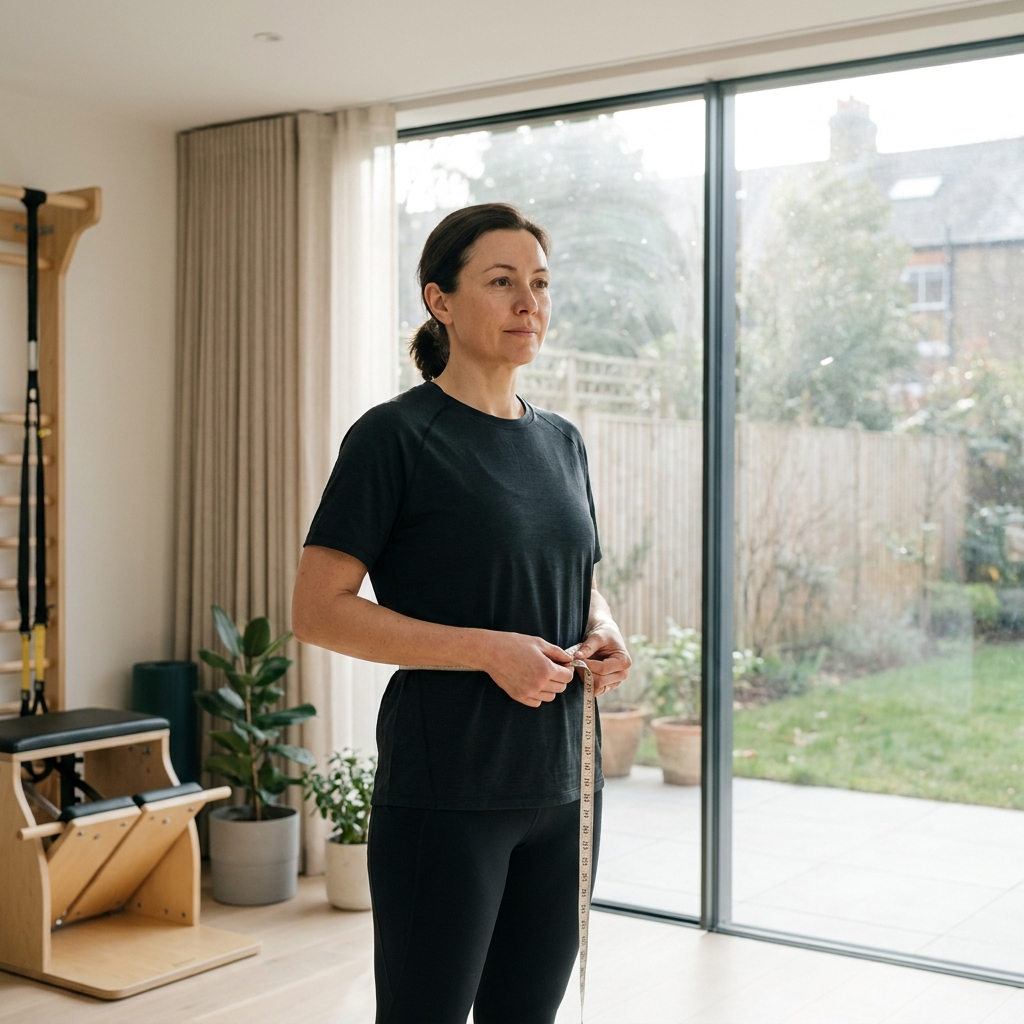
A Monthly Body Composition Protocol
Daily scale weights create anxiety without signal. Monthly body composition measurements create signal without anxiety. Here is the protocol our team uses with members who want to move past the scale.
Once per Month (Same Morning, Same Conditions)
- Wake up, use the bathroom, and do not eat or drink anything.
- Weigh yourself on the same scale, in the same room.
- Measure waist at the navel with a flexible tape, standing relaxed, at the end of a normal exhale.
- If you have a smart scale or BIA device, take the measurement now.
- Take a front, side, and back photo in the same lighting and clothing.
- Log all five numbers plus the date.
Once per Year
- Book a DEXA scan for body fat %, regional fat distribution, visceral adipose tissue, appendicular lean mass, and bone mineral density.
- Use the DEXA result to calibrate your home BIA numbers — note the gap and apply it mentally to subsequent smart-scale readings.
- Compare year-over-year to track muscle mass changes, which are slow but deeply meaningful.
Interpreting Change: Signal vs Noise
Body composition moves slowly. Expect and demand the following cadence before calling anything a trend.
- Waist circumference: meaningful change is 1 cm or more over 4 weeks; single-day variance of ±1 cm is normal from hydration and bowel contents.
- Visceral fat (BIA): meaningful change is a 1-unit drop over 8–12 weeks; 2-unit drops over 12 weeks reflect real fat loss.
- Body fat percentage (smart scale): ignore weekly swings; look for 1–2 percentage point changes over 8–12 weeks.
- Body fat percentage (DEXA): 1 percentage point is typically within measurement noise; trust 2+ point shifts year over year.
- Skeletal muscle mass: a true gain of 2–3 pounds of muscle in 6 months is excellent for a trained adult; novices can gain faster.
Stop reacting to daily or weekly numbers. React to monthly and quarterly trends. The interventions that actually build a better body composition — progressive resistance training, sufficient protein, quality sleep, reduced alcohol — all operate on monthly and quarterly timescales. Match your measurement cadence to your biology's cadence.
Can You Lose Fat Without Losing Weight?
Yes. This is one of the most common and most frustrating scenarios for people who track only the scale. Recomposition — losing fat while gaining muscle — is the dream outcome that scale-obsessed tracking completely hides.
A beginner in the first 6 months of a good resistance program, eating at maintenance calories with adequate protein, can easily lose 5 pounds of fat and gain 5 pounds of muscle. The scale moves zero. The mirror, the tape measure, the DEXA, and the energy levels all tell a completely different story. If you had been weighing yourself daily, you would have concluded the program "wasn't working" and quit.
Body composition metrics catch recomposition. The scale doesn't. This is a core reason we tell members to demote weight to a secondary measurement, not abolish it — just stop treating it as the verdict.
The Connection to Blood Work
Body composition does not live in a silo. The fat you carry and where you carry it shows up in your blood. Visceral fat drives inflammation (hs-CRP), insulin resistance (fasting insulin, HbA1c), and atherogenic lipid particles (ApoB). Muscle mass pulls in the other direction: more muscle, better insulin sensitivity, lower fasting glucose, better lipid profile.
If you want the full picture of cardiometabolic health, read body composition and blood biomarkers together. We go deep on the blood side in our guide on 5 blood biomarkers beyond cholesterol. Track both together and you have a dashboard your doctor's "normal" stamp cannot give you.
How OnePersonHealth Closes the Loop
Collecting body composition numbers is the easy part. The hard part is connecting them to the behaviors that are actually moving them — the protein you hit on 4 days out of 7, the 3 extra resistance sessions, the week of poor sleep that stalled visceral fat progress, the month of travel that erased 2 months of gains.
OnePersonHealth runs a nightly AI analysis across every data stream you connect: body composition logs, meals, training, supplements, sleep, wearable recovery, lab results. It correlates changes in your waist, body fat, and muscle mass against the interventions you've actually been doing, then tells you which levers are paying off and which ones aren't.
No dashboard to interpret. Specific morning recommendations, generated overnight. Start tracking body composition the way it was meant to be tracked — try OPH free.
When to Worry About Muscle Loss
Sarcopenia — age-related muscle loss — is the body composition risk that blindsides people. It happens slowly, it does not hurt, and the scale actively hides it if fat mass is increasing at the same time. Someone who weighs the same at 65 as they did at 35 but has lost 20 pounds of muscle and gained 20 pounds of fat is in a dramatically worse place, despite "not having gained weight."
Watch for these warning signs across your 40s and beyond:
- Grip strength decline (men below 30 kg, women below 20 kg are red flags)
- Slower walking speed (under 0.8 m/s predicts increased mortality)
- Difficulty rising from a chair without using hands
- Falling skeletal muscle mass on BIA or DEXA year over year
- Rising body fat percentage with stable weight
Resistance training is the single most effective intervention against sarcopenia, at any age. The oldest subjects in Maria Fiatarone's landmark 1990 nursing-home study — people in their 80s and 90s — gained muscle and strength on a progressive resistance program. Muscle is trainable at every age. Inaction is the only mistake that compounds.
Body Composition and Recovery
Muscle mass and visceral fat also shape how your nervous system recovers. Leaner, more muscular bodies tend to show higher heart rate variability and more efficient recovery from stress. If you track HRV alongside body composition, you have a very complete picture of both structure and function. We walk through the HRV side in how to read your HRV data.
Put This Into Action
- Demote the scale. Weigh yourself once a week at most. Stop reacting to daily numbers.
- Buy a $3 tape measure and log a baseline today. Waist at the navel, height, and waist-to-height ratio. Aim for under 0.5.
- Book a DEXA scan in the next 30 days. Budget $40–$150. This is your annual truth check.
- Set up a monthly measurement ritual. Same morning, same conditions, five numbers, three photos. Calendar it.
- Pick one upstream lever. Either add 2 resistance training sessions per week, or raise protein to 1.6 g/kg per day, or cut alcohol for 8 weeks. Not all three at once.
- Retest in 90 days. Compare monthly trends, not daily weights. Adjust the lever, then iterate.
The Bottom Line
Scale weight is a legacy metric that survives because it is cheap, fast, and familiar — not because it is accurate. Waist circumference, visceral fat, body fat percentage, and skeletal muscle mass form a dashboard that actually predicts how you will age. DIY measurement is achievable with a tape measure, a smart scale, and a yearly DEXA. The cadence is monthly, not daily. The interventions are strength, protein, sleep, and patience.
The question isn't "what did the scale say this morning?" The question is: is your waist smaller, your visceral fat lower, your muscle mass higher, and your body fat percentage drifting in the right direction — across the last 12 weeks?