
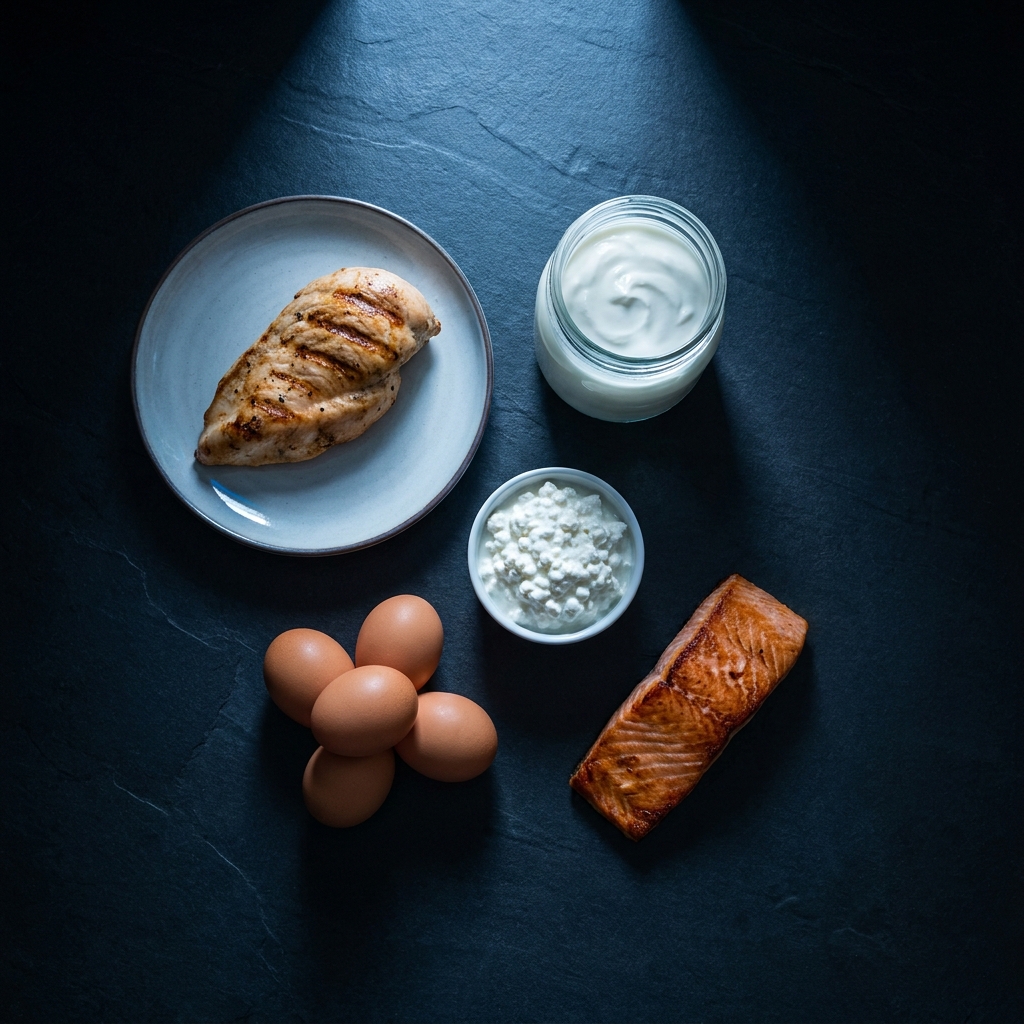
You are eating 90 grams of protein a day, you are 40 pounds into a cut, and your jeans fit differently than they used to. Not better. Different. The scale is down, but so is the mirror. That is not fat loss. That is body recomposition failing in slow motion, and almost always it traces back to one number: the protein floor.
Protein is the single macronutrient that protects lean mass during a calorie deficit. It drives muscle protein synthesis, crosses the leucine threshold that flips on the anabolic machinery, defends against sarcopenia as you age, and holds your nitrogen balance in positive territory while calories are scarce. DIAAS (the digestible indispensable amino acid score) tells us which sources actually deliver the amino acids that matter. And the research from Stuart Phillips at McMaster and Luc van Loon at Maastricht has converged on a number so tight it is almost boring: 1.6 to 2.2 grams of protein per kilogram of body weight, or roughly 0.8 to 1.0 grams per pound, for anyone resistance training in a deficit.
This guide walks you through the floor, the ceiling, the myths, and the meal-by-meal distribution that actually protects muscle while you lose fat. By the end you will know exactly how many grams of protein you need tomorrow, how to split them across the day, and which foods give you the most protein per calorie.
Key Takeaways
- Resistance trainers in a calorie deficit need 1.6-2.2 g/kg (0.8-1.0 g/lb) of body weight daily to preserve lean mass.
- Distribution matters: four meals of 30-40g protein beat two 80g bolus feedings for 24-hour muscle protein synthesis.
- The "30g ceiling per meal" is a myth for muscle growth. Your body absorbs protein regardless; synthesis is what plateaus.
- No randomized trial has linked high-protein diets to kidney damage in healthy adults. The myth came from people who already had kidney disease.
- Protein has a 20-30% thermic effect of food — you burn 20-30 calories digesting every 100 protein calories.
Medical disclaimer: This article is educational only — not medical advice. If you have chronic kidney disease, liver disease, or any condition that requires protein restriction, talk to your doctor or registered dietitian before changing your intake.
Why Protein Is the One Macro You Cannot Underdose in a Deficit
When you cut calories, your body has three sources of fuel: dietary intake, stored fat, and lean tissue. Fat is the one you want burned. Lean tissue is the one that carries your metabolic rate, your insulin sensitivity, your strength, and most of the way you feel when you catch your reflection in a window.
Protein is the switch that decides which of those your body reaches for first. Inadequate protein in a deficit pushes your body to break down muscle for amino acids, because it needs them for repair, immune function, enzyme production, and dozens of processes that do not pause because you decided to lose 20 pounds.
A 2016 study led by Thomas Longland and Stuart Phillips at McMaster University put young men on a 40% calorie deficit for four weeks. Half were given 1.2 g/kg of protein, half were given 2.4 g/kg. Both groups did resistance and high-intensity interval training. The high-protein group lost 4.8 kg of fat and gained 1.2 kg of lean mass. The lower-protein group lost less fat and held steady on muscle. Same deficit. Same training. The only variable was protein, and it rewrote their body composition.
The Protein Floor: The Exact Formula by Body Weight
Here is the number you came for. For adults who are resistance training and in a calorie deficit, the evidence-based floor is:
- 1.6 to 2.2 grams per kilogram of body weight, or
- 0.8 to 1.0 grams per pound of body weight
Use your total body weight if you are at a reasonable body fat percentage (under roughly 25% for men, under 32% for women). If you carry substantially more body fat, calculate based on a reasonable goal body weight or on lean body mass plus 15%. Protein needs are driven by lean tissue, not adipose tissue.
Protein Targets by Body Weight
Here is the floor translated into grams per day, side by side:
| Body Weight | Floor (0.8 g/lb) | Ceiling (1.0 g/lb) | Metric (1.6-2.2 g/kg) |
|---|---|---|---|
| 120 lb (54 kg) | 96 g | 120 g | 87-119 g |
| 140 lb (64 kg) | 112 g | 140 g | 102-140 g |
| 150 lb (68 kg) | 120 g | 150 g | 109-150 g |
| 160 lb (73 kg) | 128 g | 160 g | 116-160 g |
| 170 lb (77 kg) | 136 g | 170 g | 123-170 g |
| 180 lb (82 kg) | 144 g | 180 g | 131-180 g |
| 200 lb (91 kg) | 160 g | 200 g | 145-200 g |
| 220 lb (100 kg) | 176 g | 220 g | 160-220 g |
| 240 lb (109 kg) | 192 g | 240 g | 175-240 g |
Aim for the lower end if you are sedentary or in a mild deficit. Aim for the upper end if you are in an aggressive deficit, training hard, or over 50. Older adults are more anabolically resistant — the same amount of protein produces a smaller muscle-building response — which is why our team pushes clients over 50 toward 1.0 g/lb almost without exception.
Why 1.6-2.2 g/kg? The Meta-Analysis Behind the Number
The number did not come out of thin air. A 2018 meta-analysis led by Robert Morton and Stuart Phillips, published in the British Journal of Sports Medicine, pooled 49 studies and 1,863 participants. The conclusion: protein intake above about 1.62 g/kg produced no further gains in fat-free mass during resistance training. Below that, gains dropped.
The Leidy and Campbell review, a landmark paper in the American Journal of Clinical Nutrition, walked through the mechanism: higher protein improves satiety (via peptide YY and GLP-1), preserves lean mass in a deficit, and raises the thermic effect of feeding. Luc van Loon's lab at Maastricht University has spent 20 years dialing in the specific kinetics — how much leucine is needed per meal, how fast different protein sources digest, and how aging and inactivity blunt the muscle protein synthesis response.
When three independent research programs converge on the same range, that range is no longer controversial. It is the working consensus.
What About Non-Trainers and the Sedentary?
If you are not resistance training, the number drifts down but does not collapse. The RDA of 0.36 g/lb (0.8 g/kg) is explicitly a minimum to prevent deficiency, not an optimum for body composition or healthy aging. Research from Donald Layman and others suggests 0.54-0.73 g/lb (1.2-1.6 g/kg) is more appropriate for sedentary adults who want to preserve lean mass and metabolic health.
If you are over 65, the International Society of Sports Nutrition and the PROT-AGE study group both recommend at least 1.0-1.2 g/kg minimum, with 1.2-1.6 g/kg for active older adults. Sarcopenia — the age-related loss of muscle mass — is one of the strongest predictors of mortality after 70, and undereating protein accelerates it directly.
Protein Distribution: The Four-Meal Rule
Total protein is necessary. Distribution is what makes it work.
Your muscles respond to a feeding in bursts. When you eat protein, muscle protein synthesis rises, peaks around 90 minutes, and then returns to baseline within about three hours, even if you keep eating. This is sometimes called the "muscle full" effect. Bolusing 80 grams in one meal does not extend synthesis proportionally — most of it gets oxidized or used elsewhere.
Van Loon's lab has shown repeatedly that four meals of 30-40g protein, spaced roughly every 3-5 hours, produces more 24-hour muscle protein synthesis than two larger meals with the same total protein. This is the clearest free lever in the protein literature: same grams, different timing, better outcome.
The Leucine Threshold
Each meal has to clear the leucine threshold to maximally trigger muscle protein synthesis. Leucine is the branched-chain amino acid that flips on the mTOR pathway. Below roughly 2.5-3 grams of leucine per meal, the anabolic response is blunted.
This threshold translates to about 25-30 grams of high-quality animal protein, or 35-50 grams of plant protein (which has lower leucine density). If you are eating 15g of protein at breakfast, you are not clearing the threshold. You are logging protein but not activating the muscle-building machinery.
A Sample Distribution for a 180-lb Adult
- Breakfast (7am): 35-40g protein — 3 eggs + 1 cup Greek yogurt, or a 4-egg omelet with cheese, or a protein shake with milk plus oats
- Lunch (12pm): 40-45g protein — 6 oz chicken breast + salad, or salmon with rice and vegetables
- Snack (3-4pm): 25-30g protein — cottage cheese with fruit, or a protein shake, or turkey slices with cheese
- Dinner (7pm): 40-50g protein — 8 oz lean steak, or tofu stir-fry with edamame, or white fish with beans
That adds up to 140-165g. Within the floor for a 180-lb adult training in a deficit. Each meal clears the leucine threshold. Each meal triggers its own synthesis window. This is what "getting enough protein" actually looks like in practice.
Debunking the Ceiling Myth: 30g Per Meal?
You have read it on a hundred blogs. "Your body can only absorb 30g of protein per meal. Anything more is wasted."
This is a misreading of the research, and it needs to be retired. Here is what the studies actually say.
Your gut absorbs essentially all the protein you eat, up to physiologically absurd amounts. A 2023 study by Trommelen, Loon and colleagues fed participants 100g of milk protein in one sitting and tracked amino acid appearance in the bloodstream for 12 hours. The body absorbed it, used roughly 75g for tissue repair and synthesis over that window, and oxidized the rest. No ceiling for absorption.
What does plateau is the immediate muscle protein synthesis response per meal, which maxes out around 30-40g of high-quality protein. Beyond that, extra protein still contributes to whole-body protein turnover, organ repair, enzyme production, and other synthetic processes. It is not "wasted." It just is not all going straight into biceps.
The practical takeaway: there is no reason to panic-snack to stay under a 30g cap. If dinner is 60g of protein because your chicken breast was bigger than planned, your body uses it. Distribution helps optimize synthesis but is not a hard rule.
Debunking the Kidney Myth
This one has more staying power because it sounds clinical. "High-protein diets damage your kidneys."
No randomized controlled trial has ever shown that high-protein intake damages kidney function in healthy adults. A 2018 meta-analysis in the Journal of Nutrition pooled 28 RCTs and found no adverse effect of high-protein diets (defined as greater than 1.5 g/kg) on glomerular filtration rate in healthy people.
The confusion comes from one legitimate source. In people who already have chronic kidney disease, protein restriction is part of medical management because damaged kidneys struggle to clear nitrogen waste. That real clinical reality got generalized, incorrectly, into a blanket warning for the general population.
If you have kidney disease, follow your nephrologist. If your kidneys are healthy, 1.6-2.2 g/kg is well within the safe range that has been studied for decades. Bodybuilders eating 2.5-3 g/kg for years show no kidney dysfunction in study populations.
Thermic Effect: The Hidden Fat-Loss Bonus
One more reason protein is the macro that matters in a deficit. It has the highest thermic effect of food of any macronutrient.
- Protein: 20-30% of calories burned during digestion
- Carbohydrates: 5-10%
- Fat: 0-3%
If you eat 600 calories of protein, you burn roughly 150 of them just processing it. That is a free 100-150 calorie deficit per day when you run a high-protein diet, without counting appetite suppression effects. Over a 12-week cut, that is measurable fat loss that happens while you are eating, not while you are restricting.
This is one of the reasons our team recommends protein-forward eating to members hitting a weight loss plateau. The scale often stalls not because the deficit disappeared but because protein slipped and lean mass dropped, dragging metabolic rate down with it. Raising protein back to 1.0 g/lb often breaks the plateau inside two weeks.
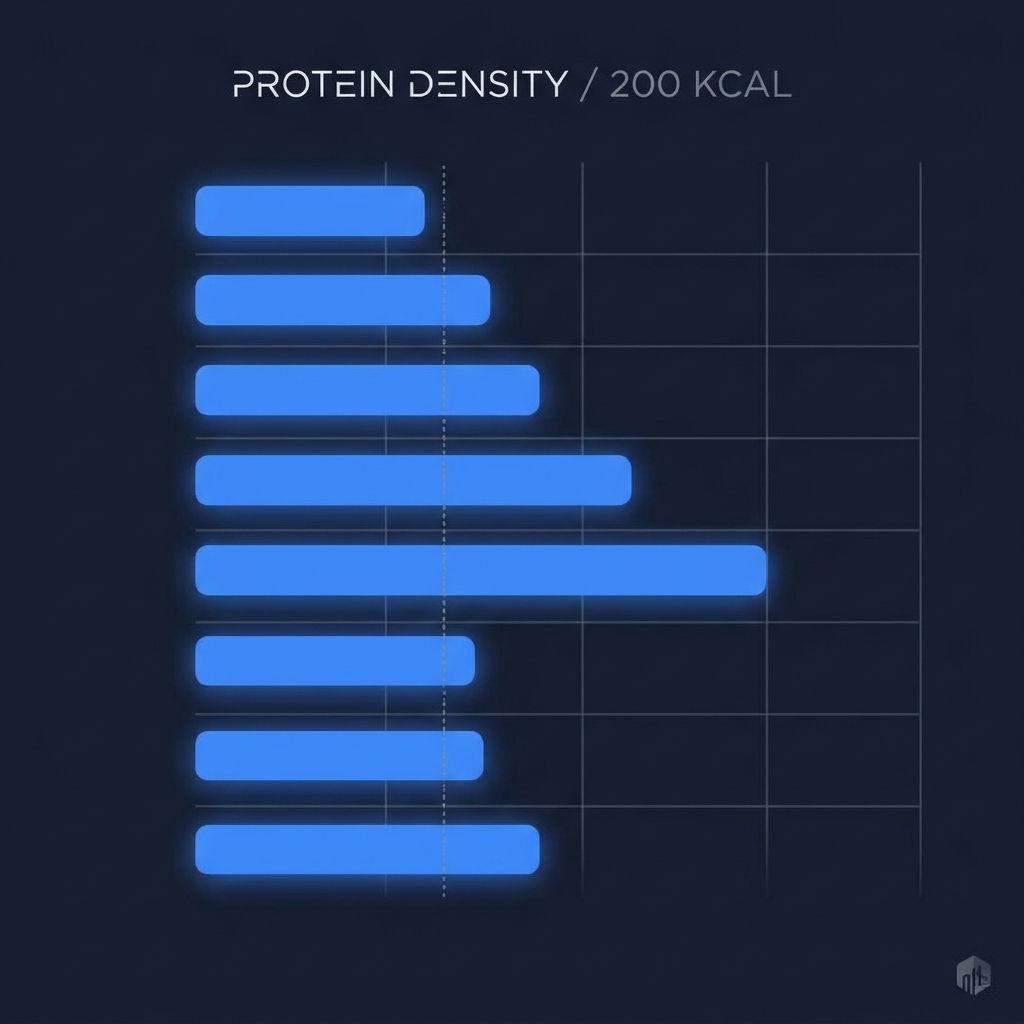
Protein Density: Grams Per 200 Calories
Not all protein sources are equal in the context of a deficit. What you want is the most grams of protein per calorie — which preserves the room in your budget for vegetables, fiber, and the carbs that fuel training.
Here is a density table for common sources. We have standardized each to a 200-calorie serving so you can compare directly.
| Food | Grams of Protein per 200 kcal | DIAAS Quality | Notes |
|---|---|---|---|
| Chicken breast (skinless) | ~43 g | Excellent (1.08) | Gold standard density |
| Egg whites | ~42 g | Excellent (1.16) | Virtually all protein, almost no fat |
| Cod or white fish | ~42 g | Excellent | Very lean, light flavor |
| Shrimp | ~40 g | Excellent | High-density, quick-cooking |
| Turkey breast | ~40 g | Excellent | Similar to chicken |
| Nonfat Greek yogurt | ~36 g | Excellent (1.07) | Convenient, high leucine |
| Cottage cheese (low-fat) | ~32 g | Excellent | Slow-digesting casein |
| Whey protein powder | ~40 g | Excellent (1.09) | Fastest leucine spike |
| Canned tuna (in water) | ~45 g | Excellent | Highest ratio of any whole food |
| Lean ground beef (93/7) | ~28 g | Excellent | Some fat calories included |
| Salmon | ~24 g | Excellent | Omega-3 bonus, higher fat |
| Tofu (firm) | ~22 g | Good (0.87) | Best plant density |
| Tempeh | ~19 g | Good | Fermented, higher fiber |
| Lentils (cooked) | ~16 g | Moderate (0.59) | Carb-heavy, fiber-rich |
| Black beans | ~13 g | Moderate | Similar carb/fiber profile |
| Quinoa | ~7 g | Moderate (0.65) | Mostly a carb source |
| Peanut butter | ~8 g | Moderate | Mostly fat by calories |
| Almonds | ~7 g | Moderate | Not a protein source |
DIAAS (digestible indispensable amino acid score) is the modern measure of protein quality, endorsed by the FAO. A score above 1.0 means the protein source meets or exceeds reference amino acid needs for a given population. Animal proteins cluster above 1.0. Soy and pea protein sit around 0.87-0.92. Single plant sources like lentils fall below 0.75, which is why plant-forward eaters benefit from combining sources — rice plus beans, hummus plus pita, or simply eating more total grams to compensate.
What About Plant Protein in a Deficit?
You can hit 1.6-2.2 g/kg on a plant-based diet. You just have to engineer it deliberately.
Three practical adjustments our team recommends for plant-based cutters:
- Eat 15-25% more total protein to compensate for lower DIAAS scores and leucine density. A 180-lb plant-based trainer should target closer to 180-200g than 144-160g.
- Lean on the high-density options — tofu, tempeh, seitan, edamame, soy milk, pea protein isolate. These are the plant sources that clear the leucine threshold at reasonable portions.
- Supplement with pea or soy isolate if whole-food density is not getting you there. Pea protein isolate hits 24-25g per scoop with a strong leucine profile.
Cronometer, MyFitnessPal, or OPH's built-in nutrition tracking makes this easy to verify rather than guess. Log three days. Look at the total. Adjust.
How to Know Your Protein Is Actually Working
The scale is a terrible signal for whether protein is doing its job in a deficit. Muscle is denser than fat, so a month of smart cutting might show only a small drop on the scale while your waist goes down two inches and your arms stay the same size. That is the outcome you want.
Better signals to watch while you cut:
- Strength in the gym. If your lifts are maintaining or slowly climbing in a deficit, your protein is working. If everything is collapsing, you are underfed somewhere.
- Tape measurements. Waist, hips, chest, arms, thighs. Take them weekly. Muscle stays, fat goes — the tape will show it before the scale does.
- Body composition, not just weight. DEXA scans, BIA scales, or InBody assessments give you lean mass and fat mass numbers. We go deep on the full toolkit in body composition metrics.
- Progress photos. Same lighting, same pose, every two weeks. The mirror lies daily. Photos two weeks apart do not.
- Hunger stability. High-protein intakes suppress appetite through peptide YY and GLP-1. If you are ravenous all day, your protein is probably too low.
Try OPH for Automated Protein Tracking
Hitting 1.6-2.2 g/kg across four meals every day for 12 weeks requires tracking. Not forever — usually 4-6 weeks is enough to internalize the portions and the distribution. But the tracking itself is where most people fail.
OnePersonHealth logs your meals conversationally — snap a photo, send a voice note, or just type "two scrambled eggs and a scoop of whey in oats" and the AI handles macros, leucine estimation, DIAAS weighting, and meal-by-meal distribution checks. Every night it audits whether you cleared the threshold on each meal and flags the specific one that dragged your 24-hour total.
Start tracking your protein the easy way — try OPH free. The AI watches your distribution, your leucine thresholds, and your daily totals while you focus on training and eating.

Common Protein Mistakes We See Every Week
Our team reviews member nutrition data daily. These are the patterns that come up most often when protein targets are missed despite apparent effort.
Mistake 1: A Coffee-Only Breakfast
Skipping breakfast means your first protein feeding is lunch at noon. That is 16 hours since dinner the night before with no amino acid delivery. Muscle protein breakdown runs unopposed during overnight fasts, and extending the fast into midday compounds the deficit. Either move breakfast back on the table or add a protein-dense mid-morning snack.
Mistake 2: Misjudging Raw vs. Cooked Weights
Most protein sources lose 20-25% of their weight to water when cooked. A 6 oz raw chicken breast is about 4.5 oz cooked. If you weigh the cooked portion and calculate as if it were raw, you are overestimating protein by 25%. Weigh raw whenever possible, and know your conversions when you cannot.
Mistake 3: Counting Low-Density Foods as Protein
Peanut butter, almonds, quinoa, and oats all contain some protein. None of them are protein sources in the context of a cut. If you are eating a tablespoon of peanut butter for "protein," you got 4 grams of protein and 100 calories, mostly fat. Reserve those foods for their real role — fat, fiber, carbs — and get protein from actual protein sources.
Mistake 4: Over-Relying on Protein Bars
Most commercial protein bars deliver 15-20g of protein in 200-250 calories. That is worse density than Greek yogurt, cottage cheese, or jerky. Bars are a convenience food, not a protein strategy. Use them when you must, not as a default.
Mistake 5: Front-Loading All Protein at Dinner
Dinner with 80g of protein plus 20g scattered across breakfast and lunch does not equal a well-distributed 100g day. The synthesis windows you missed at breakfast and lunch cannot be recovered at 7pm. Move 20-30g earlier.
Does the Type of Protein Matter for Fat Loss?
A little, but less than total and distribution. Here is the order we prioritize.
First priority: total grams per day. Get to 1.6-2.2 g/kg. If you nail this, almost everything else is noise.
Second priority: distribution across meals. Four meals clearing the leucine threshold beat two big meals plus snacks.
Third priority: DIAAS quality. Favor sources above 1.0 when possible. If you are plant-based, engineer combinations or bump total intake by 15-25%.
Fourth priority: timing around training. Having protein within 2-3 hours of resistance training is useful but not urgent. Van Loon's work has largely dismantled the "anabolic window" as a 30-minute emergency. The window is closer to 4-6 hours, and total daily protein matters more than exact timing.
Put This Into Action
- Weigh yourself tomorrow morning. Multiply by 0.8 to get your protein floor in grams. Multiply by 1.0 to get your ceiling. This is your range.
- Divide that number by four. That is your per-meal target. Most adults will land in the 30-45g per meal range.
- Plan your week around four protein anchors. Breakfast, lunch, snack, dinner. Each one built around a real protein source — eggs, chicken, fish, Greek yogurt, cottage cheese, tofu, whey.
- Track for 14 days. Log every meal. Look at your daily total, your per-meal distribution, and which meal consistently drags the average.
- Fix the weak meal. It is almost always breakfast. Add eggs, a shake, or Greek yogurt until it clears 30g.
- Retest body composition at 12 weeks. Tape measurements, progress photos, and ideally a DEXA or InBody scan. The data will tell you whether the floor is working.
The Bottom Line
The protein floor is not a mystery. It is 1.6-2.2 grams per kilogram, or 0.8 to 1.0 grams per pound, distributed across four meals that each clear a 2.5-3g leucine threshold. That is the framework Stuart Phillips, Luc van Loon, and the Morton meta-analysis have converged on, backed by decades of muscle protein synthesis research and repeated in randomized trials.
The myths — 30g absorption caps, kidney damage, the anabolic window — are either wrong or dramatically oversimplified. The real levers are total daily grams, per-meal distribution, and consistent high-DIAAS sources. Hit those three, train hard, and your body composition will handle itself, even in a deficit.
The question is not whether you are eating enough protein. The question is: do you know exactly how many grams you ate yesterday, and were they spread across four meals or dumped into one?